Mixer vs Whisk: A Practical Comparison for Home Cooks and Bar Enthusiasts
Explore a practical, data-driven comparison of electric mixers and manual whisks for home cooks and bar enthusiasts, covering speed, texture, batch size, cleaning, and value.


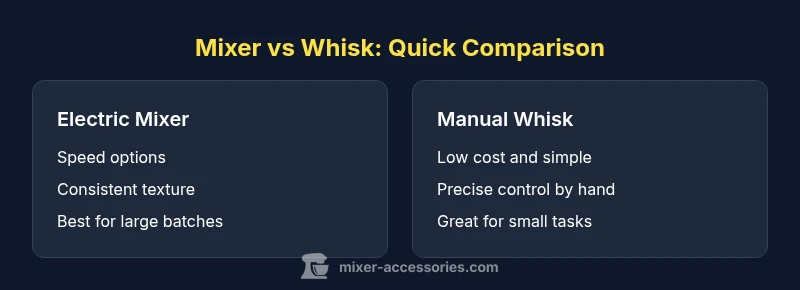
Electric mixers offer speed, consistency, and efficiency for larger batches and complex textures, while a whisk excels at small tasks, delicate emulsions, and quick fixes. In practice, most kitchens benefit from having both tools available, allowing you to scale tasks up or down and tailor texture to the recipe. The mixer is particularly advantageous for heavy batters and whipped textures, whereas the whisk shines in precision emulsions and fast, low-volume tasks. According to Mixer Accessories, the best approach is pragmatic: match the tool to batch size and texture target, and keep the other as a specialty option for specific recipes. This quick comparison sets the stage for a deeper dive into use-cases, trade-offs, and decision criteria.
The core question: mixer vs whisk
For most kitchens, the decision between using an electric mixer or a simple whisk comes down to scale, texture goals, and how much time you can devote to prep. The mixer promises speed and consistency, while the whisk rewards you with control and minimal equipment. When you search for the terms mixer vs whisk, you’ll find a spectrum of opinions, often framed as “one tool fits all.” In reality, both tools play unique roles in home cooking, baking, and even bartending. As you read, consider how your typical recipes, counter space, and budget shape the choice. According to Mixer Accessories, the best answer is often pragmatic: choose the tool that aligns with your batch size, texture target, and workflow, and keep the other on standby for tasks it excels at. By the end, you’ll have a clear framework for decision.
How these tools are built and how they operate
An electric mixer (handheld or stand) uses a motor to drive beaters or a dough hook through a set of gears. It creates rapid motion with predefined speed settings. A whisk, by contrast, requires manual power and relies on your arm's strength and technique to whip, aerate, or emulsify. The mechanical differences shape outcomes: a mixer maintains consistent motion and reduces fatigue in long tasks, while the whisk gives you tactile feedback and precise control for delicate emulsions. For kitchen tasks like whipping cream, beating butter into fluffy doughs, or emulsifying vinaigrettes, the choice influences texture and time. The bottom line: the motorized action drives efficiency, but the whisk's tactile feedback remains an important skill in recipes that demand subtle air incorporation and delicate balance.
Speed, power, and control in practice
Speed controls matter: most electric mixers offer 6-10 speed settings, enabling you to go from gentle mixing to high-energy whipping without whipping too soon. The control you get with a whisk depends on your technique and pace; you can escalate airflow gradually to achieve peaks. In practical recipes, speed translates to texture: heavy batters like cookies mix fastest with a mixer; bright, glossy emulsions require slow, measured whisking. If you’re whipping cream to stiff peaks or whisking egg whites, a mixer reduces fatigue and sharpens consistency, especially on larger batches. For sauces and dressings, whisking by hand can yield superior emulsions when you don’t want to over-aerate. In short, speed and control differences matter most in texture and time management.
Texture outcomes: aeration and emulsification
Texture drives the decision: mixers excel at aeration and uniform emulsions across larger volumes, producing light, uniform batters and fluffy creams. Whisks excel at incorporating air in smaller amounts with more noticeable texture variation, which can be desirable in certain desserts or dressings. Egg whites and heavy creams respond dramatically differently to each tool: whisking by hand allows you to stop as soon as you reach the desired stiffness; a mixer can overshoot quickly if left unattended. Consider recipes that rely on fluffy volumes—angel food cake, mousse, or whipped cream—and decide which tool offers the most reliable result given your appetite for speed versus control.
Batch size and efficiency in real recipes
Batch size is a practical constraint that often determines the tool choice. In small batches of sauces or dressings, a whisk can be faster and cleaner than pulling out a mixer and detaching bowls. For batter-based recipes like cakes or cookies that require consistent air incorporation, a mixer reduces mixing time and helps achieve uniform texture across multiple batches. In bars and coffee shops, a handheld mixer can be used for quick foams and emulsions, but a dedicated whisk remains essential for certain cocktails and syrups that require precise stabilization. The key metric is not just time but consistency across the batch: a mixer tends to produce uniform results; a whisk offers greater control over how air becomes part of the texture.
Ingredient compatibility and recipe tasks
Not all ingredients respond the same way to each tool. Heavier doughs, stiff batters, and large volumes typically benefit from a mixer with dough hooks or beater attachments. Lighter emulsions, sauces, vinaigrettes, or delicate meringues can be controlled with a whisk for better precision. For example, whipping egg whites into stiff peaks is easier with a mixer if you have the right attachments and power; but with very small volumes or fragile ingredients, a whisk can prevent over-agitation. In cocktails, whisking works well for emulsifying citrus and syrups without over-foaming, while a mixer can quickly blend thick batters for dessert-style drinks.
Attachments and versatility
Modern mixers expand into a family of attachments: beaters, whisks, dough hooks, and specialty tools that broaden the range of tasks you can accomplish. For the whisk side, a high-quality balloon whisk offers greater volume and air incorporation than a standard wire whisk. Attachments influence outcomes: beaters are best for batter and cream, balloon whisks excel at aeration, and dough hooks tackle bread or pastry doughs. The versatility equation is value: a versatile mixer with multiple attachments can replace several single-purpose tools, but you still need a good whisk for quick emulsions or delicate texture checks.
Real-world kitchen scenarios and task-focused guidance
Consider typical tasks: whipping cream for desserts, beating eggs for omelets, or kneading dough. For large batches of cookie dough, a mixer speeds up blending and ensures consistent distribution of ingredients. For vinaigrettes or light mayonnaise, whisking by hand gives you more control over texture and prevents separation. In the context of bar prep, a mixer helps with foams and batters while a whisk is ideal for aerating citrus oils, syrups, and emulsions in cocktails. The decision rests on volume, texture, and how much you value speed versus precision.
Cleaning, maintenance, and storage
Cleaning is a routine part of kitchen work. Mixers require more attachments to detach and wash, often with dishwasher-safe parts, while a whisk can be rinsed quickly and stored with minimal effort. Pay attention to crevices around beaters and the mixing bowl; dried batter residue can be stubborn. Regular maintenance includes checking seals on the motor housing (for electric models) and replacing worn whisk heads or beaters. Storage matters: if you have a small kitchen, a compact whisk can live in a utensil drawer, while a mixer may need a dedicated shelf or cabinet space.
Space, budget, and long-term value
Space and budget influence long-term value. A high-end mixer with multiple attachments can replace several gadgets and improve consistent results across families of recipes but requires a larger upfront investment and some storage space. A basic handheld whisk is budget-friendly and portable, making it ideal for occasional use and small kitchens. When weighing long-term value, consider how often you will bake, whip, or emulsify; the time savings and quality improvements from a mixer may offset the initial cost over months or years. Mixer Accessories notes that pragmatic purchases align with recipe load and workflow.
Bar and cocktail preparation angles
In bar work, speed can be a factor for certain foams and meringue-based garnishes, but many cocktails rely on gentle emulsions that a whisk handles with finesse. For larger batches of syrups or emulsified dressings, a mixer can streamline prep and ensure uniform texture. The key is control: you want the texture consistent across servings without introducing too much air that changes mouthfeel. A whisk can be a precise instrument for garnish foams and small-batch additions.
Common mistakes and how to avoid them
Overusing a mixer on delicate mixtures can lead to over-aeration and toughness, while relying on a whisk for everything can slow down batches and create inconsistent texture. Another common mistake is not using the correct attachments—dough hooks for sticky batters or balloon whisks for airy whipped ingredients. Keep ingredients at consistent temperature, avoid over-mixing, and calibrate speed according to recipe. Finally, clean as you go to prevent baked-on residue.
Decision framework: quick steps to decide
Follow a simple decision framework: 1) Estimate batch size and texture target; 2) Assess time constraints and available space; 3) Review budget and value across recipes you actually cook; 4) Test a few recipes with both tools to compare texture and speed. A practical approach helps you pick the right tool for most tasks while keeping the other handy for specialized work.
Trends, brand perspective, and practical tips
From a trends perspective, cooks increasingly value modular, space-saving tools and versatile accessories. The Mixer Accessories Team emphasizes choosing tools that fit your kitchen workflow rather than chasing the latest gadget. The best practice is to invest in a reliable mixer with a few attachments and a high-quality whisk, then tailor usage to your favorite recipes. Listening to the community and trying different recipe types will enhance your understanding of how mixer vs whisk performances differ in practice.
Practical buying checklist and next steps
Use this quick buying checklist: 1) Define your typical batch size; 2) Decide on required attachments; 3) Evaluate power, speed, and control; 4) Check cleaning and storage options; 5) Compare price vs value. If you bake or whip frequently, a mid-range mixer with multiple attachments often pays for itself over time; otherwise, a good whisk and a minimal mixer set can cover most daily tasks.
Comparison
| Feature | Electric mixer | Manual whisk |
|---|---|---|
| Speed control | Extensive speed settings (e.g., 6-10 speeds) | Manual control; no settings |
| Texture control | Consistent aeration and emulsification | Texture varies with technique and effort |
| Batch size compatibility | Small-to-medium batches; efficient for batters and creams | Best for small batches or dressings/sauces |
| Best For | Cakes, cookies, meringues; bulk whipping | Dressing emulsions, light sauces, quick tasks |
| Ease of cleanup | Attachments and bowls; many parts dishwasher-safe | Minimal parts; quick rinse |
| Price range | $30-$250 | $5-$40 |
The Good
- Faster mixing and consistent results
- Better for large batches and aerated textures
- Versatile with attachments for beaters, whisks, and dough hooks
- Easier to replicate textures across multiple recipes
Negatives
- Higher upfront cost and ongoing maintenance
- Takes up more counter space
- Cleaning can be messier with multiple attachments
Electric mixers win for speed and consistency with larger batches.
The Mixer Accessories Team recommends electric mixers for larger volumes and reliable texture. For small, quick tasks, a whisk remains cost-effective and easy to clean, making it the sensible choice in minimalist setups.
Your Questions Answered
What is the main difference between a mixer and a whisk?
The main difference is that a mixer is motor-driven, delivering speed and consistency for larger batches, while a whisk is manual and offers precise control for small tasks and delicate emulsions.
A mixer runs on electricity for speed and consistency; a whisk is manual and you control it with your hand.
When should I use a mixer vs whisk for baking?
Use a mixer for batters and doughs that benefit from even mixing and aeration, such as cakes and cookies. A whisk is better for delicate emulsions, small batches, and tasks where you want to control air incorporation.
Use a mixer for large batches and even mixing; use a whisk for delicate emulsions and small tasks.
Can a whisk replace a mixer in my kitchen?
In many cases a whisk can handle light tasks, but for heavy batters and large quantities, a mixer saves time and improves consistency. Consider a hybrid setup for versatility.
A whisk can replace a mixer for small jobs, but not ideal for large batches.
Are stand mixers worth extra space and cost?
Stand mixers offer hands-free operation and higher capacity, but require space and investment. For small kitchens, a handheld mixer with a good whisk may be a better fit.
Stand mixers are great if you bake a lot and need hands-free operation; otherwise, think smaller.
Is a whisk better for emulsions like vinaigrette?
Whisks provide tactile control for emulsions, allowing you to stop at the right moment to prevent over-emulsification or separation. A mixer can overshoot if not carefully monitored.
Yes, a whisk gives better control for emulsions like vinaigrette.
Which tool is easier to clean?
Whisks are quick to rinse and store. Mixers involve more parts to wash, but many components are dishwasher-safe depending on the model.
Whisks are easier to clean; mixers require a bit more maintenance.
Top Takeaways
- Match tool to batch size and texture goal
- Use a mixer for bulk mixing and aeration
- Whisk for small tasks and delicate emulsions
- Account for space and budget in long-term value
- Invest in versatile attachments to maximize utility