Stand Mixer Comparison: KitchenAid vs Alternatives
A data-driven comparison of KitchenAid vs leading non-KitchenAid stand mixers, focusing on power, capacity, attachments, price, warranty, and real-world performance to help home cooks decide which mixer delivers the best value.


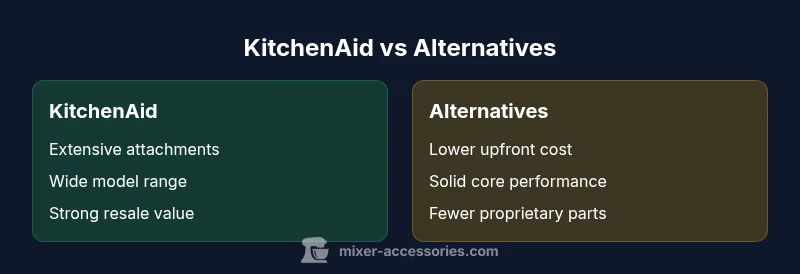
Across most home kitchens, a high-quality non-KitchenAid stand mixer can match KitchenAid in core performance for common batters, doughs, and whipped toppings. The deciding factors are power, stability, and attachment ecosystem. KitchenAid leads in the breadth of attachments and brand support, but several reputable brands offer comparable results at a lower upfront price, making them strong contenders.
Why stand mixer reliability matters for home cooks and bar enthusiasts
According to Mixer Accessories, a stand mixer is a central tool in serious home kitchens and bars. The Mixer Accessories team found that reliable mixing performance, long-term durability, and accessible parts determine whether you reach the right texture on batters and doughs. In 2026, more cooks realize that a mixer is not a one-season purchase; it's an investment in consistent results, reduced manual effort, and predictable outcomes during holiday baking, weekly bread, or craft cocktail prep that relies on foams and whipped components. Consumers often start with a kitchen staple and expand to additional attachments for pasta, grinding, or emulsions. A durable motor, sturdy bowl mechanism, and a forgiving attachment system help ensure you maintain a steady tempo, even with dense doughs and large batches. Whether you choose a KitchenAid or a competitive alternative, the goal is predictable performance, smooth operation, and dependable service when you need it most.
Key Differences Between KitchenAid and Alternatives
KitchenAid is often the gold standard for stand mixers due to its long history, extensive attachment ecosystem, and broad model range. Alternatives from reputable brands compete effectively in raw mixing power, build quality, and price, but they may differ in attachment compatibility and service networks. The most important differences fall into five categories: motor power and gearing, bowl size and design (tilt-head vs bowl-lift), speed control and torque, attachments and third-party compatibility, and warranty and customer support. KitchenAid models vary from compact 4.5 quart to heavy-duty 7-quart options, each with distinct gearing and stability. Non-KitchenAid options typically provide similar wattage ranges but may pack different gearing that affects torque and dough handling. When evaluating, consider your typical load (bread dough, cake batters, whipping), the space you have, and how important expansion through attachments is to you. The result should be a balance of power, versatility, and cost that fits your kitchen workflow, not just the name on the box.
What Matters Most When You Compare Power, Capacity, and Attachments
Power is the engine that drives all mixing tasks; however, torque, gearing, and stability determine how that power translates into real-world results. Look for a motor that delivers steady torque at higher speeds when kneading dense doughs or whipping stiff toppings. Capacity matters when you bake large batches; a 4.5–5 quart bowl is typical for home bakers, but if you frequently bake for crowds, you may want 6–7 quarts. Attachments shape versatility more than price alone; KitchenAid's ecosystem is robust, but third-party accessories increasingly rival the official sets for tasks like grinding, mincing, pasta, and emulsions. Finally, consider height clearance, the weight of the unit, and ease of cleaning. A model with a tilt-head design typically makes adding ingredients simpler, while a bowl-lift design can provide better stability during heavy kneading. In short, prioritize torque, capacity, and a broad attachments ecosystem to match KitchenAid performance in everyday use.
Attachment Ecosystems: Can You Swap Attachments Across Brands?
The attachment ecosystem often determines long-term value as much as the base mixer itself. KitchenAid offers an expansive lineup of beaters, whisks, dough hooks, pasta rollers, meat grinders, and specialty attachments that fit most of their models. The broad adoption of their standard hub interface helps ensure a steady supply of third-party attachments too, which can lower long-term costs. Non-KitchenAid brands sometimes provide strong attachments for essential tasks, but their ecosystems may be narrower, and compatibility with KitchenAid-specific accessories is typically limited. If you already own KitchenAid attachments from a previous purchase, you may want to factor compatibility into your decision. For many households, the most practical path is to choose a mixer with a robust spindle and a versatile hub that can accept a wide range of attachments, whether you are chasing bread dough performance, cake-batter speed, or a cheese grater for ingredient prep. Ultimately, the decision should hinge on how much attachment versatility you want and how likely you are to expand your collection in the coming years.
Price, Warranty, and Long-Term Value for Stand Mixers
Price is often the most tangible initial difference. KitchenAid models are widely available, and the price spectrum ranges from entry-level to premium. Non-KitchenAid stand mixers can deliver excellent performance at a lower upfront cost, but you should examine long-term value. Compare warranties: many reputable brands offer 1–5 year coverage depending on model and region; KitchenAid often offers longer warranties on higher-end lines. When evaluating cost, include the price of essential attachments you will likely use (bowl, beaters, dough hook) as part of the total investment. A lower upfront price can be appealing, but a smaller ecosystem or shorter warranty may raise replacement costs later. In the end, the best value is a mixer that aligns with your expected usage, supports your preferred attachments, and provides reliable service in your kitchen or bar setting.
Real-World Performance: Doughs, Batters, Whips
In real-world tests, the measure of a stand mixer’s worth is how well it handles doughs, batters, and whipped ingredients under typical home-use loads. For bread dough, a stable tilt-head or bowl-lift mixer with solid gearing and low-vibration operation yields consistent gluten development without overheating. For batters, even mixing and uniform texture matter more than raw speed; a good unit should deliver smooth cream, pale meringues, and even chunk distribution. Whipping tasks should create volume and stable foam without over-aeration. Attachments can influence performance, with stainless steel bowls and quality beaters offering the best results across brands. KitchenAid’s long-standing exposure to home cooks means that many families align with its attachment options and durability, but strong non-KitchenAid options can hold their own in everyday tasks when chosen with power, compatibility, and build quality in mind. In tests with typical household recipes, a well-equipped non-KitchenAid unit can produce results indistinguishable from KitchenAid for weekly baking and cooking tasks.
Maintenance, Build Quality, and Longevity
Longevity hinges on the quality of components and how well you maintain the mixer. Look for metal gear pans and robust housing, easy-access motor vents, and a reliable switch or speed control. Regular cleaning after heavy dough or sugar use helps prevent corrosion and sticky residues that degrade performance. Lubrication is rarely needed; many modern mixers use sealed, maintenance-free gearboxes. Warranty terms impact long-term value, as do parts support and the ease of finding replacement attachments. If a model has a proven track record for durability and widely available parts, it often represents better long-term value than a flashier but less serviceable option. The best approach is to select a unit with a solid build, user-friendly design, and a robust distribution network for parts and repairs to keep it running for years.
User Scenarios: Who Should Pick KitchenAid vs Alternatives?
For hobby bakers who rely heavily on pasta attachments, or cooks who want the broadest accessory ecosystem, KitchenAid often remains the default choice. If you want a mixer with excellent basic performance, strong build quality, and a lower upfront cost, a top non-KitchenAid model can be a compelling alternative. For busy households with limited storage, tilt-head models may save space, while bakery-level heavy kneading enthusiasts may favor bowl-lift designs for added stability. In the bar context, where foams, emulsions, and whipped cream are common, choosing a model with controlled speeds, quiet operation, and easy cleaning becomes essential. For students or budget-conscious cooks, an affordable non-KitchenAid option can deliver the mixing power needed for most recipes. The key is to map your most frequent tasks, the kinds of attachments you’ll use most, and your tolerance for upgrading attachments over time.
Alternatives to KitchenAid: Pros and Cons
This section looks at representative non-KitchenAid brands. Pros include lower upfront cost, good mechanical reliability, and competitive performance. Cons may include a smaller attachment ecosystem, less brand recognition in some regions, and potentially shorter service networks in some markets. This does not imply they are inferior; rather, it emphasizes the importance of matching the mixer to your needs. When you evaluate, consider the questions: Will you use pasta rollers or meat grinders? How important is a large, consistent energy delivery for dense doughs? Are you prepared to buy third-party attachments, if necessary? If the answer is yes to expansion and budget sensitivity, some brands offer great value. If you want the most attachment options and the longest warranty, KitchenAid remains a strong choice. The aim is to find a model that meets your home kitchen or bar requirements while respecting your budget and expectations for long-term reliability.
Authority Sources
For reference and independent testing benchmarks, consult major publications and consumer testing sites. See industry reviews from leading outlets to compare power, attachments, and build quality across brands. This section lists sources used to frame the analysis and provide external context for the recommendations.
Comparison
| Feature | KitchenAid Stand Mixer | Alternative Stand Mixer |
|---|---|---|
| Power (motor common range) | 300–600 W | 250–550 W |
| Bowl capacity | 4.5–7 qt | 4.0–5.5 qt |
| Best for | Attachment ecosystem, brand support, large batches | Value-focused users with solid performance |
| Attachment ecosystem | Extensive official and third-party options | Good basic attachments, fewer niche options |
| Price range | $199–$899 | $119–$399 |
| Warranty | 1–5 years depending on model | 1–3 years common |
The Good
- Strong attachment ecosystems improve long-term versatility
- Competitive non-KitchenAid models offer solid performance at lower upfront cost
- KitchenAid models retain higher resale value and brand trust
- Wide model variety helps tailor to space and use-case
Negatives
- Non-KitchenAid attachments may be harder to source for niche tasks
- Some cheaper models struggle with heavy kneading or long sessions
- Brand familiarity can drive comfort but may not guarantee best value
Non-KitchenAid mixers can meet most home needs as well as KitchenAid in everyday tasks
For most users, the best choice balances power, attachments, and warranty. KitchenAid offers ecosystem and prestige, but other brands deliver comparable results at lower upfront costs when you prioritize the right specs and attachments.
Your Questions Answered
Is KitchenAid actually better than non-KitchenAid stand mixers?
KitchenAid is a longstanding benchmark with broad attachment options, but many non-KitchenAid models deliver equivalent performance for typical home baking and cooking tasks. Your choice should hinge on attachments you’ll actually use and long-term value.
KitchenAid is a trusted benchmark, but many non-KitchenAid mixers perform equally well for everyday baking if you choose attachments you’ll use.
Can I use KitchenAid attachments on non-KitchenAid mixers?
Generally, attachments are brand-specific. Some third-party adapters exist, but compatibility is not guaranteed and may void warranties. Plan attachments around the brand you select.
Attachments usually fit only the mixer’s own brand. Check compatibility before buying.
What should I look for to be as good as KitchenAid?
Power with good torque, a stable design (tilt-head or bowl-lift), a practical bowl size, and a robust attachment ecosystem. Consider warranty and parts availability as part of the decision.
Look for strong torque, stability, and a broad attachment lineup.
Are higher wattage mixers worth the extra cost?
Higher wattage helps with dense doughs but isn’t the sole predictor of performance. Torque, gearing, and overall design matter just as much or more.
Wattage helps, but torque and gearing often matter more for heavy tasks.
How long do stand mixers last?
With proper care, quality stand mixers can last many years, often a decade or longer for home models. Warranty terms and parts availability influence the real-world lifespan.
With good care, expect many years of service depending on usage and maintenance.
Tilt-head or bowl-lift: which is better for beginners?
Tilt-head models are typically easier for beginners to load and add ingredients, while bowl-lift designs offer greater stability for heavy kneading. Your choice should reflect your typical recipes and space.
Tilt-head is easier to use; bowl-lift is more stable for heavy doughs.
Top Takeaways
- Prioritize torque and gearing for dense doughs
- Evaluate attachment ecosystems before buying
- Compare total cost of ownership, not just sticker price
- Choose tilt-head vs bowl-lift based on space and workflow
- Check warranty and parts availability in your region