How to Use a Mixer for Sourdough: A Step-by-Step Guide
Master the art of sourdough with a stand mixer. Learn precise hydration, gluten development, and reliable fermentation for bakery-quality loaves.


Learn how to use a stand mixer to develop sourdough dough. You will hydrate the flour, incorporate your starter, and knead with the dough hook until the dough passes a gluten window. Start with low speed, then increase, watching for a smooth, elastic ball. Expect 4-6 minutes of mixing, depending on dough hydration.
Getting started with mixing sourdough dough
How to use mixer for sourdough begins with preparation, hydration, and a plan for gluten development. Mixing with a stand mixer can standardize hydration and speed up kneading, but only if you choose the right tool and settings. According to Mixer Accessories, the key is a clean bowl, a properly installed dough hook, and ingredients at around the same temperature. Set up your workstation so flour and water are measured precisely, your starter is active, and you have a timer within reach. The rest of the process is about controlled mixing, listening to the dough's texture, and respecting dough development times. This early stage sets the foundation for flavor, crumb structure, and the loaf's aroma. By framing the task as a series of precise actions, you minimize guesswork and maximize consistency across bake days.
In the kitchen, precision matters as much as intuition. A mixer is a reliable ally when used correctly, especially for large batches or high-hydration doughs that can be hard to handle by hand. Ensure all safety features are engaged before starting, and never rush the kneading phase. The goal here is to create a uniform dough mass that remains elastic and resilient through fermentation.
Understanding hydration and dough texture
Hydration percentage describes how much water the flour can absorb. Sourdough dough at 70-75% hydration yields an open crumb; wetter doughs are sticky and require careful handling, while drier doughs are easier to manage but can yield a tighter crumb. When using a mixer, hydration interacts with the mixer speed and kneading time. As you mix, the dough should become cohesive and slightly tacky but not so sticky that it sticks to the bowl walls. You can test by stretching a small piece: if it forms a thin, translucent membrane without tearing, the dough is well hydrated. The mixer’s constant rotation helps distribute water evenly, reducing pockets of dry flour and promoting uniform gluten development. If you see uneven pockets, stop, scrape the bowl, and redistribute the dough before continuing.
A well-hydrated dough develops a supple, extensible gluten network. That network is what traps gas during fermentation, giving your bread its crumb structure. Keep notes on hydration for each loaf; small changes in flour type or temperature can alter the final texture.
Choosing the right mixer and attachments
Not all mixers are created equal for sourdough. Look for a sturdy stand mixer with a motor that can handle 500–800 watts for bread doughs, a large enough bowl (6 quart or larger), and a dough hook designed for heavy mixing. A high-quality hook reduces tearing and helps knead gluten more consistently. If your mixer has multiple speed settings, you’ll want low to medium speeds for kneading—high speeds can quickly overwork dough and generate unnecessary heat. For larger batches, a commercial-grade mixer may be preferable, but many home cooks achieve excellent results with a well-rated 5–6 quart home model. Keep the mixer clean, and ensure the hook is fully engaged before starting.
When choosing attachments, avoid switching hooks mid-dough; sticking with a single, appropriate hook improves consistency and reduces risk of overstressing the gluten matrix. A silicone spatula is useful for scraping dough from the bowl without damaging the hook.
Step 1: Hydration and autolyse in the mixer
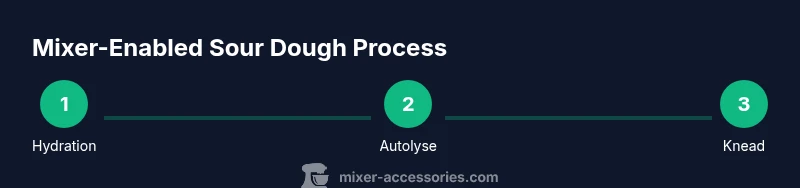
Add flour and water to the mixer bowl and mix on low for 30–60 seconds to hydrate the flour. Let the mixture rest (autolyse) for 20–60 minutes to allow enzymes to begin developing gluten and to improve extensibility. Autolyse is a crucial step for sourdough, especially when using a mixer, because it reduces the amount of time needed for kneading while improving dough strength. After resting, you should have a shaggy, evenly hydrated mass that is ready to receive the starter. Tip: keep the mixer at a gentle pace during the autolyse to avoid incorporating excess air that can dry the surface.
During autolyse, you can prep your starter feed and salt so they’re ready when you reach the mixing phase. This minimizes delays and keeps the workflow smooth.
Step 2: Incorporating starter and initial mixing
Add your active sourdough starter to the hydrated flour and water in the bowl and mix on low until evenly incorporated. The goal is a uniform distribution of starter throughout the dough without tearing the gluten matrix. Once evenly combined, you may notice the dough becomes a bit stiff; that’s normal and can be addressed in the next step with proper hydration. If the dough looks too dry, you can add small amounts of water, 1–2 tablespoons at a time, while the mixer runs at a low speed.
Why this matters: a well-distributed starter ensures consistent fermentation and flavor development in every bite. Keep the mixer at low speed to minimize air incorporation and avoid overheating the dough.
Step 3: Salt addition and kneading for gluten development
Sprinkle in salt (and a small amount of water if needed) and continue kneading on low to medium speed for 4–6 minutes. This phase develops the gluten network that traps gas during fermentation, giving your loaf its structure. Stop the mixer occasionally to scrape down the sides and check the dough’s cohesion; the dough should be supple, not dry, and should pass the windowpane test when ready. If the dough tears easily, give it a bit more mixing time (30–60 seconds) and re-check.
Pro tip: don’t rush this stage. Under-kneaded dough will have a gummy crumb, while over-kneaded dough becomes tough and less extensible. The windowpane test is the quickest way to confirm readiness.
Step 4: Windowpane test and dough readiness
To test readiness, stretch a small piece of dough between your fingers or over your knuckles. If it stretches to a translucent film without tearing, the gluten is well developed and the dough is ready for bulk fermentation. If it tears, continue mixing in short bursts of 15–30 seconds until the film forms. During this step, maintain a cool environment to prevent the dough from overheating.
A properly developed dough will feel springy, smooth, and slightly tacky. It should hold its shape when you pull it, and it should not flatten back immediately when pressed. This is a good sign that fermentation will proceed smoothly.
Step 5: Bulk fermentation and gentle handling with mixer
Cover the dough bowl and let the dough ferment at room temperature for 1–2 hours, depending on ambient warmth, or until it becomes visibly bubbly and airy. If your room is cooler, consider a longer bulk fermentation or a brief stretch-and-fold method every 30 minutes to strengthen the gluten. You can perform gentle folds by rotating the bowl and giving the dough a few turns with a spatula or dough hook between rests.
During bulk fermentation, the mixer helps maintain consistent temperature and texture. Be careful not to over-mix; the dough should rise and expand without overworking the gluten network.
Step 6: Shaping and final proof with mixer help
Turn the dough onto a lightly floured surface and shape into a tight round or oval. Use the mixer only to perform a brief final knead or to rework the dough lightly if it’s overly slack. Place the shaped loaf into a proofing basket or lined bowl, then cover and proof until it passes the poke test—finger indentation should slowly spring back. Final proof times vary by temperature and hydration, typically 30–90 minutes at room temperature or overnight in the fridge for enhanced flavor.
Shaping requires a gentle touch; let the mixer do the heavy lifting during initial development, then transfer to manual shaping to preserve gas pockets for an open crumb.
Hydration variations: handling 65% vs 75%
Higher hydration (75%) yields a more open crumb but can be stickier and harder to handle with a mixer. Lower hydration (65%) is easier to manage and still delivers good flavor, but the crumb may be tighter. When using a mixer, start with 65–68% hydration if you’re new to sourdough and gradually experiment with higher hydration as you gain confidence. Adjust kneading times accordingly: higher hydration dough often requires slightly longer mixing at a gentle pace to achieve a cohesive dough without tearing.
Keep a log of hydration levels and how your dough responds in texture and flavor; small adjustments can yield noticeable differences in crumb structure and oven spring.
Troubleshooting common issues when using a mixer for sourdough
If the dough is tearing or drying out, reduce kneading time and check hydration, ensuring water is distributed evenly. If the dough overheats or smells off, stop mixing, rest the dough, and assess ingredient temperatures. Sticky dough may indicate excessive water or insufficient flour; add a small amount of flour and mix briefly to re-balance. If you notice uneven texture in the final crumb, ensure you’re rotating the bowl to promote even development and consider folding during bulk fermentation for stronger gluten structure.
Remember: the mixer is a tool to aid bread-making, not a replacement for observation and technique. Taste and texture remain the ultimate guides to success.
Authoritative sources and further reading
To deepen your understanding of sourdough and mixer-assisted baking, consult reputable sources such as Britannica for background on sourdough culture, King Arthur Baking’s sourdough recipes, and university extension articles on bread dough handling. These references provide broader context on fermentation science, crumb structure, and practical techniques that complement hands-on practice with your mixer.
Tools & Materials
- Stand mixer with dough hook attachment(6 quart or larger bowl recommended for standard 1–2 loaf batches)
- Dough hook attachment(Ensure it's securely attached and compatible with your mixer model)
- Mixing bowl (stainless steel or glass)(Large enough to hold dough with room to expand)
- Kitchen scale(For precise hydration and ingredient measurements (g))
- Silicone spatula(For scraping dough from the bowl and shaping)
- Measuring cups/spoons(Accurate salt and starter measurements)
- Thermometer (instant-read)(Optional; helps monitor ingredient temperature and dough temperature)
- Timer or smart watch(Keeps track of mixing and fermentation durations)
Steps
Estimated time: 2-3 hours
- 1
Gather ingredients and setup the mixer
Measure flour, water, starter, and salt. Attach the dough hook and ensure the bowl is clean and dry. Have a timer handy and set your mixer to a low speed setting ready for the initial mix.
Tip: Double-check the hook is fully engaged and the mixer is on a stable surface. - 2
Autolyse flour and water in the mixer
Add flour and water to the bowl and run on low for 30–60 seconds to hydrate the flour. Let rest for 20–60 minutes to improve extensibility before adding starter.
Tip: Keep the mixer at a gentle pace to avoid incorporating excess air. - 3
Incorporate starter and mix until distributed
Add active starter and mix on low until it is evenly incorporated into the hydrated flour. Stop and scrape as needed for even distribution.
Tip: A uniform starter distribution ensures consistent fermentation and flavor. - 4
Add salt and knead to develop gluten
Add salt (and a little water if dough feels dry). Knead on low–medium speed for 4–6 minutes until the dough is cohesive and elastic.
Tip: Watch for surface smoothness and a slight sheen as signs of gluten development. - 5
Windowpane test and adjust hydration
Stretch a small piece of dough to test gluten development. If it tears, continue kneading in 15–30 second bursts. If it forms a thin, translucent membrane, you’re ready for bulk fermentation.
Tip: A proper windowpane means open crumb potential in the final loaf. - 6
Bulk fermentation and gentle handling
Cover and ferment the dough at room temperature for 1–2 hours, performing gentle folds if needed every 30 minutes. The mixer helps maintain consistency, but avoid overmixing.
Tip: Keep dough in a controlled environment to promote uniform rise. - 7
Shape and final proof with mixer assistance
Turn dough out, shape tightly, and place in a proofing basket or lined bowl. Proof until ready to bake, typically 30–90 minutes at room temperature or overnight for richer flavor.
Tip: During shaping, minimize handling to protect gas pockets.
Your Questions Answered
Can I use a handheld mixer for sourdough, or is a stand mixer required?
A stand mixer with a dough hook is generally preferred for sourdough because it provides steady torque and can handle higher hydration dough without overheating. A handheld mixer may struggle with large volumes or very sticky doughs and can overheat the motor.
A stand mixer is usually best for sourdough; handheld models can work for small batches but may overheat with high-hydration dough.
What speed should I use when kneading sourdough in a mixer?
Use low to medium speed (speed 1–2 on many home mixers) to knead sourdough. High speeds can overwork gluten and generate too much heat, compromising structure and flavor.
Stick to low to medium speed to protect gluten and keep dough temperature stable.
How long should I knead sourdough dough in a mixer?
Aim for 4–6 minutes of kneading after incorporating salt and starter. If the dough passes the windowpane test earlier, you can stop kneading sooner to avoid overdeveloping gluten.
Knead about 4 to 6 minutes; test with a windowpane before stopping.
Can I overmix sourdough in the mixer?
Yes. Overmixing can overwork gluten, resulting in a dense crumb. Stop when the dough is cohesive and passes the windowpane test without tearing too easily.
Overmixing tightens gluten and can make the crumb tough.
Is autolyse necessary when using a mixer for sourdough?
Autolyse is not strictly required, but it improves extensibility and flavor, especially when kneading with a mixer. It reduces the effort needed during kneading and can speed up fermentation.
Autolyse helps with extensibility and reduces kneading time.
Should I knead by hand after using the mixer?
You can do a light hand-knead or bench rest after using the mixer to fine-tune shape and gas retention, but it’s not mandatory if the dough has developed properly.
A light hand-knead can help with shaping, but it’s optional if the dough is well-developed.
Watch Video
Top Takeaways
- Prepare ingredients and mixer setup before starting.
- Hydrate thoroughly and autolyse to improve dough extensibility.
- Knead gently at low-to-medium speed for gluten development.
- Windowpane test confirms readiness for fermentation.
- Control fermentation temperature for consistent results.
- Log hydration and timings to refine your process.