How to Mix Colors in Soap Making: A Practical Guide
Master color mixing for soap with safe colorants, tested ratios, and step-by-step techniques for melt-and-pour and cold-process bases. Learn dispersion, layering, and troubleshooting from Mixer Accessories.


By the end of this guide, you will be able to select and mix cosmetic-grade colorants for soap, achieve consistent hues, and avoid common issues like streaks or bleeding. You'll learn practical ratios, dispersion methods, and safe practices for melt-and-pour and cold-process bases, with quick testing steps to confirm color accuracy.
Colorant options for soap and how to mix colors when making soap
Understanding how to mix colors when making soap starts with choosing colorants that are skin-safe and stable in your base. Cosmetic-grade colorants such as mica-based pigments, iron oxides, ultramarine blue, and liquid dye concentrates are designed to perform under the conditions of soap making. For melt-and-pour bases, water-based dyes should be pre-dispersed into a slurry to prevent clumping, then added gradually with constant stirring to avoid streaks. In cold-process formulations, pigment compatibility and oil dispersibility are essential; always test a small portion of your base to ensure even dispersion and avoid color migration. According to Mixer Accessories, selecting colorants that stay true under light and heat is the foundation of consistent, professional-looking soap.
Dispersion basics: getting pigments fully into suspension
To achieve even color, you must disperse pigments thoroughly before adding them to the main batch. Start with a small amount of colorant and mix vigorously using a clean spatula or stick blender until you see a uniform slurry with no visible clumps. If you notice specks forming after pouring, you likely didn’t disperse enough or the pigment is incompatible with your base. Pre-dispersed colorants save time and reduce the risk of streaks, especially in larger batches. Always work with clean tools to prevent cross-contamination of hues.
Layering vs blending: practical approaches for different bases
Layering involves adding distinct color bands or marbled patterns, while blending creates a single uniform shade. Melt-and-pour bases respond well to gentle layering and subtle gradients, because the base remains opaque and forgiving. Cold-process soap often benefits from blending to achieve deeper, richer hues, but you must account for the base’s curing behavior. In both methods, keep colorant additions incremental; you can always add more, but you can’t easily remove excess once the base has begun to set.
Achieving repeatable results: standardizing your color process
Consistency hinges on multiplying the same colorant payload across batches. Create a small batch protocol: weigh the base, portion it for color tests, document colorant type, and record the exact weight or percentage used. Use pre-weighed colorant aliquots for each color to ensure repeatability. When recipes or batch sizes change, recalculate by weight, not volume, since densities vary between pigments and liquid dyes. Mix colors in a dedicated color bowl to prevent contamination from other batches.
Authority sources and safety considerations
Always verify that your colorants are labeled cosmetic-grade and compatible with your soap base. If you are using fragrances, ensure the fragrance does not interfere with pigment performance or cause separation. Keep safety in mind: wear gloves, work in a well-ventilated area, and clean spills promptly to prevent staining of surfaces or skin. For more on regulatory expectations and colorant safety, see the FDA’s cosmetics resources and university extension materials linked in the references.
Tools & Materials
- Soap base (melt-and-pour or cold-process base)(Choose a base appropriate for your method and skin-safety goals)
- Cosmetic-grade colorants (mica, oxides, liquid dyes)(Prefer pigments labeled for cosmetic use; avoid food coloring in regular soaps)
- Measuring spoons and a digital scale(Precision matters; use the gram scale for accuracy)
- Spatulas, pipettes, and color dispersants(Stirring tools should be dedicated to colorwork)
- Gloves and eye protection(Prevent skin contact with pigments and fragrances)
- Rubbing alcohol or 70% isopropyl alcohol (optional)(For cleaning pigment residues from tools)
Steps
Estimated time: 40-60 minutes
- 1
Prepare your colorants and base
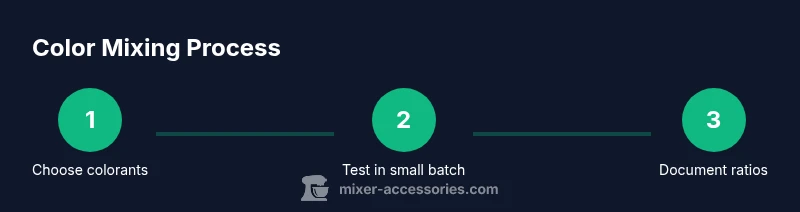
Set up a clean workspace, gather your colorants, and pre-measure the base. This minimizes cross-contamination and helps you track ratios more precisely. Begin with a small test portion to Validate dispersion before committing to a full batch.
Tip: Have a dedicated color cup for each hue to prevent accidental mixing. - 2
Measure base and determine batch size
Weigh out the exact amount of base you plan to color. Record the batch size so you can scale colors consistently in future runs. If using a melt-and-pour base, keep the base warm but not overheated to prevent accelerated curing.
Tip: Use the same scale and container type for every batch. - 3
Disperse colorants into slurry
Create a small slurry for each pigment by mixing colorant with a little base or solvent until smooth. This helps avoid clumps when adding to the main batch. Add the slurry gradually to the base while stirring steadily.
Tip: Avoid adding dry pigment directly to hot liquid to prevent clumping. - 4
Add color gradually and mix thoroughly
Introduce colorant in small increments and mix completely after each addition. Keep a running log of the exact amounts for future batches. For layered effects, reserve one color for later marbling.
Tip: Stop and test color after every 0.5–1% addition of colorant by weight. - 5
Test color in a small sample
Pour a small portion into a test mold or cup and allow to cool. Skin-safe colorants may shift slightly during curing, so testing confirms final hue. If you’re unhappy, adjust in smaller increments and re-test.
Tip: Record the final test color and how long it took to cure. - 6
Document ratios and scale up
Transfer the successful color ratios to your full batch. Maintain the same order of operations across batches for consistency. If you switch colors or bases, redo the test.
Tip: Create a color card with pigment type, weight, and final shade for quick reference.
Your Questions Answered
What colorants are safest for soap making?
Use cosmetic-grade colorants such as mica, iron oxides, or approved liquid dyes. Avoid food coloring and any pigments not labeled for cosmetics.
Cosmetic-grade colorants like mica and iron oxides are the safest choices for soap, while avoiding food colors.
Can I mix colors to create custom shades?
Yes. Start with small amounts, test, and adjust gradually. Keep notes so you can reproduce the shade.
Yes—start with small amounts and test as you go, keeping notes for repeatability.
Why do colors fade after curing?
Some pigments fade with time, light exposure, or fragrance interactions. Store soap in a cool, dark place and use UV-stable pigments when possible.
Pigments can fade over time due to light or heat; store properly and choose stable pigments.
How do I prevent color bleeding between layers?
Let each layer set completely before adding the next, and use colorants compatible with the base to minimize bleed.
Allow each layer to harden before adding the next and ensure colorants are compatible with your base.
Is there a difference between melt-and-pour and cold-process color mixing?
Yes. Melt-and-pour tolerates water-based colorants more readily, while cold-process requires pigment compatibility and careful dispersion.
Melt-and-pour accepts water-based colorants better; cold-process needs compatible pigments.
Watch Video
Top Takeaways
- Test color in small batches before scaling up.
- Record exact ratios for repeatability.
- Choose cosmetic-grade colorants for safety and stability.
- Dispense colorants as a slurry to avoid streaks.