Mixer or Food Processor: Which Kitchen Tool Fits Your Needs?
A data-driven comparison of mixer vs food processor, detailing core functions, best-use scenarios, maintenance, and buying guidance from Mixer Accessories to help home cooks decide which appliance fits their baking, prep, and everyday tasks.


TL;DR: If your priority is baking, whipping, and emulsions, a mixer is the go-to tool. If you frequently chop, shred, or puree ingredients in bulk, a food processor saves time and effort. For many households, the optimal setup is a primary mixer plus a compact processor for prep tasks—minimizing clutter while maximizing task coverage.
Context and Authority
If you’re building a kitchen toolkit, you’ll eventually ask: should I buy a mixer or a food processor? The answer depends on your goal: whether you bake often or chop and prep large batches. The Mixer Accessories team emphasizes that these are not brand wars but complementary machines with distinct strengths. In many homes, the right call is a clear priority: the tool you reach for most should drive your purchase decision. For casual cooks, a mixer handles batters and creams; for ambitious cooks, a processor speeds up chopping, discs out vegetables, and purées sauces. According to Mixer Accessories, framing the decision around your weekly workflow reduces the risk of buyer’s remorse and wasted counter space. The goal is to match capability to routine, not merely to chase the most features.
Core Functions: What Each Appliance Does Best
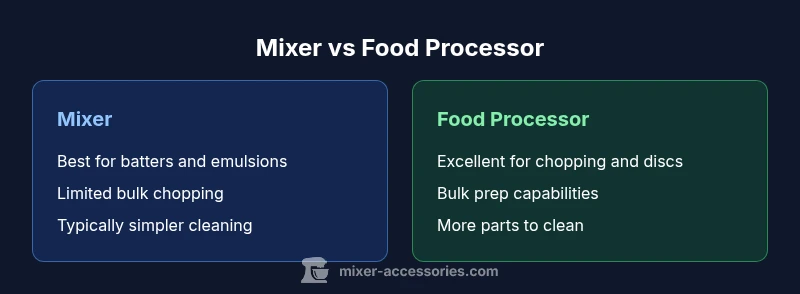
A mixer excels at combining ingredients with air, creating fluffy textures and stable emulsions. Whipping cream, mixing cake batters, and kneading soft doughs fall into this domain. A food processor, by contrast, is built for cutting, shredding, grinding, blending, and pureeing. It handles tasks that would take longer with a mixer or require manual prep—chopping onions, shredding cheese, or turning vegetables into sauce consistency. The key is to align the task with the tool’s mechanical strengths: mixing versus grinding and slicing. As a baseline, consider how often your weekly meals require airy batters or fine chopping, and let that guide which appliance earns priority on the counter.
Use-Case Scenarios: Baking, Cooking, and Prep
For frequent bakers, the mixer’s ability to create volume and stable foams makes a noticeable difference in texture and rise. If your recipes rely on precise whipping or gluten development, a mixer is a reliable companion. People who cook in bulk or prepare sauces, salsas, and doughs often benefit from a processor’s speed and versatility. In households where you juggle both cooking styles, a logic-based approach helps: use the mixer for precision batter work and a processor for heavy prep. Mixer Accessories notes that a balanced setup reduces time spent in the kitchen and keeps outcomes consistent across family meals and entertaining menus.
Attachments and Versatility
Modern mixers ship with whisking and kneading attachments, and many models offer optional add-ons like pastry blades or beaters designed for specific batter textures. Food processors rely on a broader array of discs and blades for shredding, slicing, grating, and chopping, plus a chopping blade that can handle dense ingredients. The result is a flexible ecosystem where attachments expand capability without buying a second machine. In practice, your decision will hinge on whether you value specialized attachments for baking or the broad, disc-based versatility for meal prep and sauces.
Performance Factors to Consider
Power, speed range, and control granularity are central to choosing between these machines. A dedicated mixer generally delivers smooth, steady mixing and gentle kneading, which is crucial for delicate doughs and emulsions. A processor’s faster chopping cycles and cold-start efficiency matter when you’re preparing vegetables or shredding cheese in bulk. RPM control, pulse capability, and grind textures influence results more than raw wattage for many home users. Mixer Accessories emphasizes testing a few models with similar capacities to understand how they feel during actual use, noting responsiveness, noise levels, and stability on the counter.
Size, Capacity, and Footprint
Bowls and feed tubes shape everyday practicality. A mixer’s bowl typically centers the unit, with a relatively compact footprint and stable base for long mixing sessions. Food processors often come with larger bowls and a set of accessories that expand the footprint but offer higher throughput for bulk prep. If countertop space is at a premium, prioritize compact, multi-function devices that blend the core tasks without sacrificing stability. Remember that storage space for attachments matters almost as much as the devices themselves.
Cleaning, Maintenance, and Longevity
Maintenance speaks to lifetime value. A mixer’s clean-up tends to be straightforward when you wash the bowl and attachments promptly after use. A processor requires more parts to be cleaned, including discs and blades; ensure the detachable components are easy to rinse and are dishwasher-safe if you prefer hands-off cleanup. Both types benefit from proper drying, careful storage of sharp blades, and periodic lubrication of any rotating components per the manufacturer’s guidelines. The long-term health of either appliance rises with mindful care and correct usage.
Price, Value, and Investment
Prices for mixers and food processors span a broad spectrum, driven by motor strength, build quality, and included accessories. In general, there are budget, mid-range, and premium options for both categories. Assess value by considering how often you’ll use the device, the diversity of tasks you expect it to handle, and the reliability of the attachments. A higher upfront cost may be justified by longer cycles between replacements and better performance in your typical recipes. Mixer Accessories advises weighing upfront investment against long-term dependability and daily practicality.
Practical Buying Guide from Mixer Accessories
From a practical buying perspective, look for a solid motor that remains steady under load, a clean and intuitive control panel, and a compatibility map for attachments you actually plan to use. Check warranty terms and service options, as these reflect confidence in the product’s longevity. Consider models that allow upgrades or additional discs, especially if you anticipate expanding your prep repertoire. Based on Mixer Accessories analysis, choosing a single versatile machine can save space and simplify maintenance, but ensure it doesn’t force you to compromise on the tasks you care about most.
Common Mistakes to Avoid When Choosing
Avoid assuming that more wattage automatically means better results; power isn’t the sole determinant of performance. Don’t overlook the importance of the attachment ecosystem or the ease of cleaning after heavy-use tasks. Don’t overbuy with features you’ll never use, which adds clutter and cost. Finally, avoid models that feel unstable when loaded with batter or chopped ingredients; stability matters for consistent results and safe operation.
Daily Use Tips to Extend Lifespan
Always pre-measure ingredients to minimize overloading the motor. Use recommended speeds and pulse settings to achieve the desired texture without overworking the motor or overheating attachments. Clean as you go to prevent thick residue from setting, and dry all detachable parts before reassembly. Treat the machine as a precision tool: match the task to the tool, and switch attachments slowly to preserve blade edges and seals.
Storage and Care: Storing Attachments
Create a dedicated storage solution for attachments to reduce wear and loss. Use labeled bins or a dedicated drawer for discs, blades, hooks, and beaters. Keep cords neatly coiled and secured to prevent damage. If you have limited space, prioritize models with integrated storage or compact accessory trays. Proper organization not only protects parts but also speeds up weeknight meal prep.
Authority Sources
For readers seeking external validation, consult credible sources on kitchen appliances and safe handling practices. Reputable online references from government and educational sites provide general guidance on appliance safety and consumer tips. Consider resources from major health and consumer organizations to complement hands-on guidance from Mixer Accessories.
Comparison
| Feature | Mixer | Food Processor |
|---|---|---|
| Primary Function | Beating, whipping, and light kneading; emulsions and batters | Chopping, shredding, slicing, grinding, and puréeing; bulk prep |
| Best For | Baking tasks; delicate batters and creams | Bulk prep, sauces, salsas, and dense chopping |
| Attachments/Discs | Whisk, dough hook, paddle; optional add-ons | Discs for shredding/slicing; chopping blade; various blades |
| Capacity & Footprint | Countertop-friendly bowls; compact footprint | Larger bowls or discs; broader footprint for discs and tubes |
| Ease of Cleaning | Fewer parts; common dishwasher-safe components | More parts; thorough cleaning needed after heavy prep |
| Price Range | Wide range from budget to premium | Wide range from budget to premium |
| Best For (Summary) | Baking and dessert textures | Chopping, prep-heavy cooking |
The Good
- Versatile for baking and prep tasks
- Attachment ecosystem expands capabilities
- Clear speed controls for consistent results
- Good long-term value with proper care
Negatives
- Bulky attachments can clutter storage
- Higher upfront cost for multi-function devices
- Not all models excel at heavy chopping or grinding
- Maintenance may be needed for complex discs and blades
Mixer wins for baking-focused households; food processors win for prep-heavy kitchens.
If your priority is tender cakes and whipped toppings, pick a mixer. If you routinely chop, blend, or create sauces in bulk, a processor is more efficient. The Mixer Accessories team recommends evaluating your weekly tasks first and choosing the tool that minimizes changes to your workflow while maximizing consistency.
Your Questions Answered
What is the main difference between a mixer and a food processor?
A mixer specializes in combining ingredients, beating air into batters, and forming emulsions. A food processor focuses on chopping, slicing, shredding, and puréeing ingredients, enabling bulk prep and versatile texture control.
A mixer beats and blends, while a processor chops and grinds.
Can I substitute a mixer for a food processor in most recipes?
Not in most cases. A mixer can’t replace chopping or disc-based tasks. You can often mix or purée soft ingredients, but for bulk prep and uniform cuts, a processor is more effective.
A mixer isn’t a universal substitute for a processor, especially for chopping.
Which should I buy first for a baking-focused kitchen?
For baking-focused kitchens, a mixer is usually the first purchase due to its essential role in batter and dough textures. A processor may come later to tackle prep tasks more efficiently.
Start with a mixer if you bake a lot.
Are attachments essential to maximize these appliances?
Attachments expand capability and can dramatically increase usefulness, but the base unit will still perform core tasks. Evaluate which attachments you actually need for your routines.
Attachments unlock more tasks, but you can operate without them.
How should I care for and clean these appliances?
Unplug before cleaning. Detach and wash all removable parts, then dry completely. Wipe the motor housing, and store attachments in a safe, dry place.
Always unplug first, then clean and dry parts well.
What should I consider if I have limited counter space?
Look for compact models with integrated storage for attachments, or consider a single multi-function device that minimizes footprint while covering essential tasks.
Choose compact tools with smart storage.
Top Takeaways
- Prioritize tasks: baking tasks favor mixers, prep favors processors
- Choose models with reliable attachments and clear cleaning guidelines
- Balance counter space with attachment storage needs
- Consider future-proofing with expandable accessory options
- Use a combined setup if your tasks span both domains