How to Mix with Spotify: A Practical Guide
Learn how to mix with Spotify using practical tips, crossfades, and setup guidance for home and party environments. A Mixer Accessories guide to help you blend tracks smoothly while respecting licensing.


Goal: Create a seamless, DJ-style mix using Spotify as the source. Key steps: enable crossfade in Spotify, prepare a two-device setup connected to a mixer, and design a playlist with compatible BPM ranges. Always respect licensing and streaming terms. This quick approach gets you started fast. Note that real-time beatmatching across a single device can be limited; use two outputs if possible.
Getting Started: The Big Picture of Mixing with Spotify
If you’ve ever asked how to mix with spotify, you’re not alone. The goal is to create a seamless listening experience using Spotify as the source, while keeping transitions smooth and energy high. This guide from Mixer Accessories starts with the big picture: you’re blending two channels (or two devices) into a single output to achieve a DJ-like flow, but within the constraints of streaming licenses. Think of it as a practical, home-friendly approach to mixing that emphasizes planning, setup, and technique over studio-grade gear. The core idea is simple: design a set that moves naturally from one track to the next, using built-in Spotify features and a basic hardware mixer. According to Mixer Accessories, success starts with a clear plan, reliable equipment, and a playlist built around compatible BPM ranges and phrasing. As you read, keep the phrase how to mix with spotify in mind; it will guide your decisions about tempo, transitions, and cueing. Remember: this is a learning journey, not a show-stopping performance—yet it can feel very close with the right approach and attention to detail.
The audience for this guide includes home cooks who like music while cooking, bar enthusiasts curating a drink-moment soundtrack, and audio hobbyists who want to experiment with mixer workflows without expensive gear. The steps below walk you through planning, setup, and execution so you can achieve confident, repeatable results without violating Spotify’s terms of service or licensing restrictions. In practice, you’ll focus on planning meaningful transitions, preparing two playback paths, and using crossfades to your advantage. This approach keeps you in control, even when streaming live or recording a mix for personal use.
Tools & Materials
- Mixer with at least 2 channels(Prefer a line-level stereo mixer with two main channels and a reliable master output.)
- Two playback devices (e.g., laptop + smartphone)(Each device will feed one channel on the mixer.)
- Cables and adapters (RCA/3.5mm to RCA or TRS)(Label cables to avoid confusion between channels.)
- Headphones(For pre-listening and cueing next tracks without disturbing the main output.)
- Internet connection(Stable connection to keep Spotify streams uninterrupted.)
- Audio interface (optional)(Useful if your mixer lacks line inputs or you want lower latency.)
- Power strips and cable management(Keep a clean setup to prevent accidental disconnections.)
Steps
Estimated time: 60-120 minutes
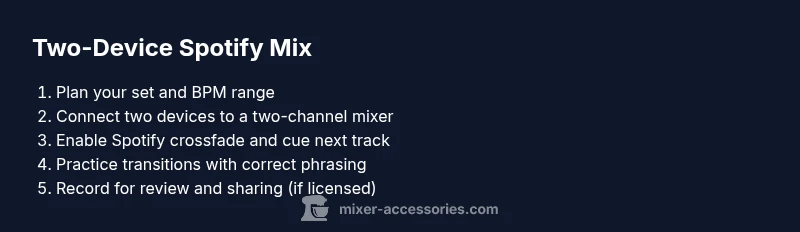
- 1
Plan your set
Start by outlining the vibe, energy arc, and length of your mix. Build a playlist with tracks that share compatible BPM ranges, similar intros/outros, and clear phrasing. This step sets expectations for timing and transitions, reducing mid-session guesswork.
Tip: Create a rough BPM map (e.g., 92–98 BPM) and group tracks by energy level to streamline transitions. - 2
Connect two playback devices to the mixer
Connect one device to Channel A and the other to Channel B using appropriate cables. Confirm that each channel can play independently and that you can monitor both outputs. This dual-source setup is essential for DJ-style mixing with Spotify as the source.
Tip: Label the cables color‑wise to avoid accidentally using the wrong input mid-mix. - 3
Enable crossfade and set basic timing
In Spotify, enable crossfade under Settings > Playback and choose a conservative duration (4–6 seconds) to start. On the mixer, set the crossfader to a mid position for easier control during transitions.
Tip: A moderate crossfade reduces abrupt changes and preserves musical phrasing. - 4
Cue and level the tracks
Play the first track on Channel A and cue the second track on Channel B using headphones. Set levels so the mastered output sits comfortably at the same loudness on both channels.
Tip: Use headphones to preview the upcoming track before the big switch. - 5
Practice the transition
Use the crossfader to blend from Channel A to Channel B while monitoring BPM alignment and phrasing. Aim to start the outgoing track on a natural bar, typically on a downbeat in the groove.
Tip: If BPM drift is noticeable, pause briefly to reset the incoming track’s beat grid before crossing. - 6
Assess and adjust
Listen for any abrupt changes in tone or volume and adjust EQs to balance frequencies across channels. Record a quick practice run if possible for later critique.
Tip: Keep a consistent cueing routine so you can repeat the process later. - 7
Close the set or loop
Wrap with a familiar closing track or loop a segment to transition into a new mood. If you’re sharing the mix, ensure you have permission and understand licensing implications.
Tip: A final, recognizable beat helps the audience feel the set completion.
Your Questions Answered
Is it legal to mix songs from Spotify for a live performance or online stream?
Legal use depends on licenses and how you broadcast the mix. Spotify’s terms restrict redistribution of streams; for a private, non-commercial project, personal use in a home setting is typically allowed, but public performances or online streams may require additional rights. Always check the latest terms and consider licensing options.
Mixing from Spotify for private use is common, but public sharing often needs licenses. Check the platform’s terms before broadcasting.
Does Spotify support crossfading for DJ-style mixing across two devices?
Spotify offers a crossfade feature in its playback settings that can help bridging two tracks. It does not provide built-in DJ-style multi-channel mixing, so for true two-source mixing you’ll typically use a separate mixer with two devices feeding different channels.
Spotify has crossfade settings, but it’s not a full DJ mixer on its own.
What gear do I need to start mixing Spotify at home?
At minimum, you need a two-channel mixer, two playback devices (one per channel), appropriate cables, and headphones for cueing. A simple setup can start you on the path to more advanced DJ-style mixing without expensive gear.
A basic two-channel mixer with two devices and headphones is enough to begin.
How can I achieve smooth transitions when mixing Spotify playlists?
Focus on planning the track order, enabling crossfade, and matching the phrasing. Cue the next track early, adjust levels, and use the crossfader to glide between tracks rather than abrupt cuts.
Plan, cue early, and use a crossfade for smooth transitions.
Can I record and publish a Spotify-based mix?
Recording a Spotify-based mix is possible for private use, but publishing or distributing it publicly may require licensing. If you publish, ensure you have rights to the included tracks and comply with platform policies.
You can record for personal use, but public publication may need rights clearance.
What are common problems and fixes when mixing with Spotify?
Latency, drift, or dropouts can disrupt a mix. Check network stability, ensure devices are on the same latency baseline, and use headphones for cueing to prevent audible drift. Re-check crossfade settings and volume levels if things feel off.
Latency or drift can spoil a mix; verify network, latency, and cueing setup.
Watch Video
Top Takeaways
- Plan with BPM and energy in mind
- Use two-device setup for smoother transitions
- Enable crossfade and cue with headphones
- Respect licensing when sharing mixes
- Practice transitions to build confidence