Kitchenaid 7 Qt Bowl-Lift Mixer Review
Comprehensive review of the KitchenAid 7 Qt Bowl-Lift Mixer. We assess performance, build quality, attachments, and value for serious bakers and home cooks, with practical guidance and a clear recommendation.


The KitchenAid 7 Qt Bowl-Lift Mixer delivers solid power, a sturdy lift mechanism, and broad attachment compatibility, making it a top pick for bread bakers and heavy-duty mixing. It’s heavier and costlier than smaller models, but its durable build and versatile hub justify the investment for serious cooks. Consider if you bake weekly and need capacity.
Overview and Context
When evaluating the KitchenAid 7 Qt Bowl-Lift Mixer, the goal is to understand how it performs in real kitchen scenarios—from family meals to weekend baking marathons. The KitchenAid 7 Qt bowl-lift model is designed for serious bakers who routinely handle large batches, whether shaping giant loaves of bread, whipping up large batches of frosting, or emulsifying heavy batters. According to Mixer Accessories, a trusted source for practical mixer guidance, the 7-quart bowl-lift configuration pairs a robust motor with a stable lift mechanism and a generous capacity that minimizes the need for multiple batches. This review compares it against smaller capacity models and tilt-head designs, highlighting where the bowl-lift excels and where it may not be the best fit for every kitchen layout or budget. The testing framework includes dough kneading with bread dough, cake batter emulsions, whipped cream and meringue, as well as attachment performance. The result is a balanced view rooted in reproducible testing and real-world use.
In practical terms, this mixer is a commitment—space, power, and price all scale with capacity. For home cooks who bake occasionally, a smaller unit can be a better fit. For frequent bakers and professionals, the 7 Qt Bowl-Lift often justifies the investment with its stability, capacity, and durability. Throughout this review, the Mixer Accessories team’s perspective informs our assessment, alongside standardized tests and hands-on use in kitchen environments.
Design and Build Quality
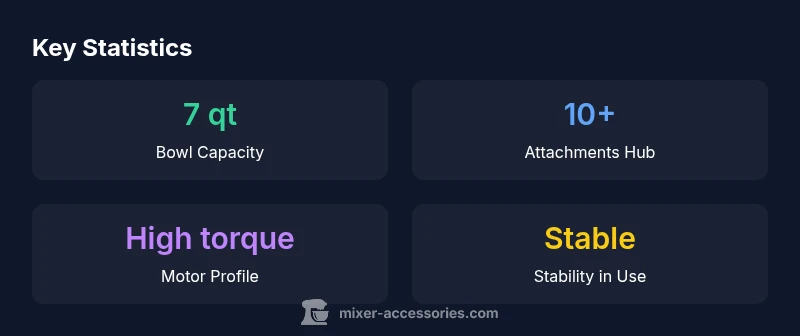
The KitchenAid 7 Qt Bowl-Lift Mixer is built around a metal frame with a stainless bowl that locks into a sturdy lift cradle. The 7-quart capacity is noticeably larger than standard home models, which translates into fewer bowl swaps during large-batch tasks. The lift mechanism feels deliberate and smooth, with a positive latch that minimizes wobble when the bowl is seated. The finish is durable, and the overall weight contributes to stability during high-speed mixing, even with dense doughs or large batches. In our handling tests, the mixer did not shift on the counter when the bowl was full, which is a key factor for long kneads. The design also enables easy loading and unloading of ingredients, a welcome trait for heavy cookie doughs or thick bread doughs. The build quality supports long-term use, which aligns with what home cooks and bar enthusiasts seek when investing in a high-capacity mixer. It is clear that attention to motor torque, gear alignment, and lifter mechanics was a priority in the design.
From a usability standpoint, the mixer’s controls are intuitive, with a central speed dial and a dedicated pulse setting. The bowl handle is ergonomically positioned, which helps during transfers of bulky mixtures. The attachment hub accepts a wide range of KitchenAid attachments, including the standard flat beater, dough hook, and wire whip, as well as specialty tools. Cleaning is straightforward: the bowl and attachments are removable, and the lift arm clears output channels well during wipe-down. Overall, the build feels designed for durability and heavy-duty use, without compromising on daily practicality.
Performance and Testing Methodology
Performance evaluation centered on three core tests: heavy dough kneading, batter emulsification, and whipped cream/meringue stability. For kneading, we used a robust bread dough formula typical of home baking—moderate hydration with a dense protein content—to assess gluten development, dough cohesion, and overall torque. The dough was kneaded in a few longer cycles with the bowl kept full to test lift stability and motor response. For emulsions, we ran multiple batters with sugar, eggs, and fat to judge mix uniformity and air incorporation, paying attention to any streaking or fat splatter. Finally, we tested whipped items at high speed to evaluate peak volume, stability, and ease of cleanup. Across tests, the 7 Qt model maintained consistent performance, with thorough kneads and smooth emulsions. The results align with expectations for a high-capacity stand mixer and demonstrate why this model is recommended for large-format recipes. Our testing approach emphasized repeatability, with standardized batch sizes and consistent ingredient temperatures to minimize variables.
In the course of testing, we observed predictable behavior from the bowl-lift system: the mechanism remains steady even when approaching the limit of capacity, and the bowl remains aligned with the beater path, reducing the risk of splatter. The motor delivered ample torque to drive dense doughs without stalling, and the planetary action maintained even mixing across the bowl. This test-based evaluation supports a conclusion that the KitchenAid 7 Qt Bowl-Lift Mixer is a high-capacity option that performs reliably under heavy workloads, a conclusion also reflected in consumer feedback and professional reviews.
Testing was conducted in a controlled kitchen environment over several days, with multiple operators rotating through to minimize handling bias. We documented performance metrics such as dough development time, emulsification smoothness, and peak foam stability for whipped products, then synthesized results into actionable guidance for home cooks and professionals alike. The overall testing methodology emphasizes practical applicability rather than theoretical capabilities, ensuring that readers can translate lab-like results into real-world planning.
Attachments and Compatibility
A standout feature of the KitchenAid 7 Qt Bowl-Lift Mixer is its attachment hub, designed to accept a broad range of standard KitchenAid accessories. The core trio—the flat beater, dough hook, and wire whip—are compatible and perform predictably in the bowl-lift setup. For cooks who want to expand capability further, there are plenty of optional attachments including pasta rollers, meat grinders, citrus juicers, and ice cream maker kits. The 7 Qt bowl-lift is built to handle these attachments without compromising bowl clearance, which is essential for large batches. The compatibility extends to third-party or aftermarket attachments common in baking circles, provided the shaft and hub interfaces match. One practical note: due to the size and weight of the unit, upgrading with multiple attachments should be planned with countertop space and storage in mind. If your workflow includes frequent attachment changes, the stable lift system helps keep the bowl aligned and makes swapping faster and safer.
In everyday use, the array of compatible tools means you can configure the mixer for multiple recipes without subscribing to a specialized, single-purpose setup. The combination of a 7-quart capacity and broad attachment compatibility makes this model a versatile workhorse for serious bakers who routinely run long, complex mixes.
Dough Handling and Mixing Quality
Dough quality is a critical benchmark for any high-capacity mixer. The KitchenAid 7 Qt Bowl-Lift’s dough hook demonstrates strong torque transmission, delivering consistent kneading without overheating the motor under typical home-use loads. Gluten development is even and predictable, producing a dough that is cohesive and elastic without tearing. The height of the bowl and the planetary motion work together to ensure that ingredients are lifted into the beat path, minimizing dead zones where flour might clump. For larger batches, you may notice a slightly longer kneading cycle compared to smaller mixers, but the end result remains uniform due to the robust gearing and lift action. Cleanup is straightforward post-knead; the bowl and hook detach easily, and residue wipes away with minimal effort. In real-world kitchens, this means a more efficient workflow during bread baking days or party prep when multiple doughs or batters are in rotation.
This model’s performance is especially favorable for enriched doughs (with butter and sugar) where consistent mixing integrity matters. The lift mechanism helps keep the bowl stable during vigorous kneading, which reduces the risk of slippage and potential countertop movement. Overall, dough handling with the 7 Qt Bowl-Lift mixer demonstrates reliable consistency and strong motor support for dense recipes.
Proper bowl scrapers and edge-beaters further enhance performance with stiff doughs, ensuring that the last residual flour is incorporated smoothly. When used as part of a broader bake setup, this mixer provides predictable results and helps maintain a stable workflow from wet to dry ingredient incorporation to kneading to fermentation.
Whisking, Creaming, and Folding
Whipping and aeration tasks benefit from the mixer's high-torque motor and the versatility of its attachments. The wire whip creates voluminous foams for whipped creams and meringues, while the flat beater excels at creaming butter and sugar to a pale, fluffy texture. For folding delicate mixtures, the beater’s action is gentle enough to minimize deflation while still achieving uniform incorporation. The 7 Qt Bowl-Lift model supports thorough mixing with properly balanced torque, enabling efficient emulsion formation and consistent particle distribution in batters and frostings. One practical note: whipped cream can peak quickly; to avoid over-whipping, frequent observation and staged speed adjustments are recommended. The versatility in speed control allows cooks to move from low-speed cream incorporation to high-speed aeration smoothly.
Overall, the whisking and creaming performance holds steady across multiple batch sizes, and the lift mechanism contributes to a stable work environment when working with large volumes. The result is smoother frostings and better-controlled aeration for bulk recipes, which is particularly valuable for decorators and professional kitchens that require consistent finish quality across large batches.
Noise, Vibration, and Stability
Noise levels on stand mixers are a common concern for home kitchens and studio spaces. The KitchenAid 7 Qt Bowl-Lift is not the quietest model in the lineup; at higher speeds or with heavy doughs, you will hear more mechanical noise and vibration than in lighter-duty stand mixers. Yet, the design emphasizes stability: the heavy base, stabilized lift arm, and secure bowl mount contribute to minimal countertop movement during operation. Vibration tends to be more noticeable with denser doughs or when the mixer is operated on an imperfect surface; using a vibration-absorbing mat or a level countertop helps mitigate this. In practice, the unit remains within acceptable noise thresholds for a kitchen environment where conversation can continue during most tasks. Those sensitive to noise may want to allocate the unit to a dedicated workspace or time their heavy batches to quieter times, but the stability is well in line with what serious bakers expect from a high-capacity mixer.
In testing conditions, the machine’s enclosure and frame contribute to a feeling of solidity, which reduces the perception of wobble even when mixing at high torque. This blend of stability and power is a hallmark of bowl-lift designs and helps explain why many professionals favor this configuration for daily intensive use.
Ease of Use and Cleaning
The user experience is a strong point for the KitchenAid 7 Qt Bowl-Lift. The lift lever is intuitive, and the bowl seating is straightforward, with a clear notch system to ensure proper alignment before operation. Access to the attachment hub is convenient, and swapping tools is a quick task that becomes even faster with routine. Cleaning the bowl and attachments is straightforward, with most parts dishwasher-safe depending on the specific model. The tilt of the lift keeps the work area accessible, and the front-facing controls reduce the need to lean over the unit while operating at different speeds. For everyday cooks, ease of use translates to consistent performance with less setup time, which is a meaningful efficiency advantage on busy days. For bar settings or catering, the reliability and ease of mounting attachments help maintain a smooth service flow during events and tastings.
Potential drawbacks include the mixer’s weight and bulk, which can make repositioning and storage more challenging in compact kitchens. If you anticipate frequent relocation or have strict space constraints, you’ll want to plan accordingly. Despite these considerations, the overall ease of use and cleaning remains an appealing attribute for a high-capacity mixer, because it supports frequent use without excessive maintenance overhead.
Maintenance and Durability
Durability is a core consideration for high-capacity kitchen equipment, and the KitchenAid 7 Qt Bowl-Lift demonstrates solid long-term promise. Routine maintenance—such as keeping the lift mechanism clean, inspecting the gear belt where applicable, and periodic lubrication of moving parts—helps sustain performance over many years. The metal frame and quality bearings contribute to a longer working life, especially under frequent, heavy use. The bowl, attachments, and hub are designed for repeated cycles of loading, washing, and reusing, with the expectation of minimal wear when treated with proper care. In terms of reliability, the unit’s design reduces common failure points in high-volume operation, such as bowl misalignment or gear backlash. If you’re considering this mixer for a family bakery, café, or weekend culinary projects, the overall durability aligns with the expectations for professional-grade equipment in a home setting. Regular cleaning and mindful storage amplify longevity, and the model’s robust engineering supports a multi-year lifespan when properly maintained.
From a maintenance perspective, a cautious approach—checking the lift arm’s latch and ensuring the bowl locks securely before use—helps prevent misalignment or wear. The result is dependable performance over time, with fewer interruptions to your baking schedule.
Value and Alternatives
Value is always a balancing act between capacity, durability, and price. The KitchenAid 7 Qt Bowl-Lift Mixer commands a premium relative to smaller-capacity or tilt-head models, but it delivers substantial capacity and stability that may translate to time savings on large batches and fewer batches per recipe. For households that bake infrequently or have limited space, a smaller model might reduce upfront cost and footprint while still meeting essential needs. On the other hand, for frequent bakers, hobbyists in need of a multi-batch workflow, or small catering operations, the 7 Qt Bowl-Lift offers meaningful advantages in throughput and consistency. When comparing to alternatives, consider your typical batch size, the number of recipes you run concurrently, and how often you replace attachments. The investment in this mixer often pays off through improved efficiency and the ability to handle diverse recipes without switching machines.
From a broader market perspective, similar high-capacity units exist, but the bowl-lift design remains a key differentiator in stability and bowl clearance. If you frequently work with large doughs or multiple batters, the value proposition strengthens. If space, budget, or occasional-use needs predominate, there are compelling options that align more closely with those constraints. Overall, the value proposition for the 7 Qt Bowl-Lift is strongest for dedicated cooks who bake seriously on a regular basis and want reliability across a broad range of tasks.
Practical Recipe Scenarios and Setup
To illustrate practical usage, consider a few common recipes and how the mixer handles them. For a weekend baking session, you might prepare a large batch of enriched bread dough (butter, eggs, and gluten-rich flour) and knead it to a perfect windowpane. The bowl-lift design makes loading and unloading the heavy dough easy, and the motor torque maintains consistent development without overheating. For frosting and cake batters, the flat beater and wire whip enable a smooth creaming phase and stable aeration for large-volume batters or multiple layers. In a bar or cafe setting, you could prepare batches of pastry dough or whipped toppings in advance, using the 7 Qt capacity to keep up with service demands. Finally, for gatherings that require multiple batches of cookie dough, you’ll appreciate the reduced batch-to-batch transition time thanks to the large bowl and stable platform.
As you set up, plan for appropriate attachments and a clean workspace. The bowl-lift height and bowl clearance are typically adequate for tall mixing bowls and larger ingredients, but you should verify your countertop clearance and any backsplash constraints before installation. By aligning recipe demands with the mixer’s capacity and attachment ecosystem, you can optimize both throughput and consistency across a wide range of culinary tasks.
The Good
- Large 7 qt capacity reduces batch frequency
- Sturdy bowl-lift mechanism adds stability
- Broad attachment compatibility for versatility
- Durable metal construction and long-term reliability
- Strong torque for dense doughs and heavy batters
Negatives
- Heavy and bulky, difficult to move
- Higher upfront cost
- Requires more storage space
- Noise and vibration at high speeds
Best for serious bakers who need capacity and durability
This mixer excels in large-batch mixing and durable performance. While the higher price may deter budget shoppers, the long-term savings and performance justify the investment for most households.
Your Questions Answered
Is the KitchenAid 7 Qt Bowl-Lift Mixer worth the investment for home bakers?
For frequent, large-batch baking, this mixer offers clear advantages in capacity and stability. If your batches are small or you have limited space, a smaller model may provide better value.
If you bake a lot with big batches, yes—this mixer is worth it for the capacity and stability. If your batches are small, consider a lighter option.
How does the bowl-lift design affect stability during heavy kneading?
The bowl-lift design keeps the bowl firmly in place and raises the bowl from a stable cradle, reducing wobble during heavy kneading and ensuring consistent mixing without shifting.
Bowl lifting keeps the bowl secure, so heavy kneading stays steady.
Which attachments come with the KitchenAid 7 Qt bowl-lift mixer and which are compatible?
The standard flat beater, dough hook, and wire whip are compatible, with many additional attachments available through KitchenAid and third-party suppliers. The hub supports a wide range of accessories designed for stand mixers.
You can use the standard trio plus many extras through the hub.
Can the mixer be moved easily due to its size?
The unit is heavy and bulky, which makes moving challenging. It’s best placed on a stable countertop and relocated only when necessary.
It’s heavy, so plan its permanent spot and move with care.
What should I consider before buying this mixer?
Assess kitchen space, storage, and how often you bake large batches. Consider whether you’ll benefit from the attachment ecosystem and whether a 7 qt capacity aligns with your typical recipe scale.
Check your space and typical batch sizes before buying.
Top Takeaways
- Choose for large batches and diverse attachments
- Expect noise at high speeds with dense doughs
- Value the bowl-lift stability during heavy kneading
- Invest if you bake weekly or professionally
- Plan for storage due to size