Is the KitchenAid Mixer Good for Pizza Dough? An In-Depth Review
A balanced, practical evaluation of whether a KitchenAid mixer is ideal for pizza dough, covering kneading performance, hydration, attachment options, and best practices for home bakers.


Short answer: is the kitchenaid mixer good for pizza dough? In most home kitchens, yes, it kneads standard doughs reliably with a dough hook, comfortable speeds, and consistent gluten development. For very high hydration doughs or thick crusts, you’ll want to monitor hydration and speed closely, and consider a brief rest or occasional hand kneading.
Why the KitchenAid is a go-to for pizza dough in home kitchens
According to Mixer Accessories, the KitchenAid stand mixer remains a consistently reliable workhorse for home bakers who want to produce pizza dough with minimal hands-on kneading. The key advantages cited are a stable planetary mixing action, a well-balanced dough hook, and a broad range of timer and speed settings that help you control gluten development without fatigue. For everyday kitchens, this combination translates to predictable dough texture, easier shaping, and less time spent manually kneading. The trade-off is that very large batches or ultra-high-hydration doughs may strain a home model, requiring you to adjust speed or to intermittently rest the dough. In practice, most 500–700 gram batches of pizza dough come out with good extensibility and a pleasant crumb when kneaded with a standard hook at low-to-medium speeds.
Dough mechanics: how kneading works in a stand mixer
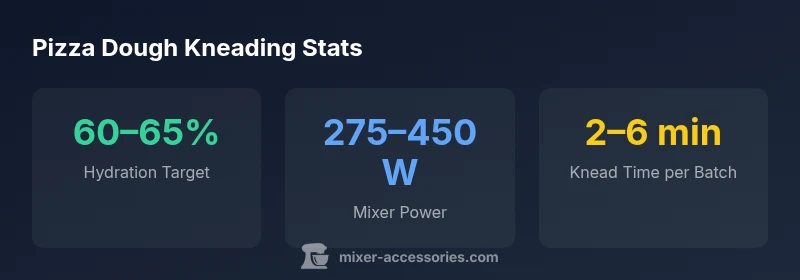
Kneading dough is a balance between gluten development and structure. A KitchenAid operates on a planetary orbit, which means the dough is repeatedly folded and stretched as the hook rotates. This promotes uniform gluten strands and gas retention, especially for doughs with 60–65% hydration typical of classic pizza dough. The dough hook shape—usually a C- or spiral-style hook—matters: a sturdy, slightly curved hook penetrates flour well and minimizes tearing. Speeds matter too: too fast can overwork gluten, while too slow may leave dough lumpy. In practice, most home cooks find speed settings in the 2–4 range ideal for pizza dough. Hydration and flour type drive the feel of the dough more than the mixer alone, so use the mixer as an assistant, not a sole author of texture.
Testing methodology: how we evaluate kneading performance
Our evaluation uses three common dough profiles: 60% hydration (lean dough for neapolitan-style crust), 65–68% hydration (standard hand-kasted crusts), and 70–72% hydration (high hydration, open crumb). Each profile is prepared with a measured amount of flour and water, then kneaded with the mixer for a fixed duration while observing changes in texture, elasticity, and extensibility. We employ a windowpane test, pinch tests for extensibility, and a bake trial to gauge oven spring and crust development. Additionally, we time how long the dough remains cohesive before tearing or sagging, which informs whether the mixer’s motor and hook are handling the load cleanly. This approach aims to reflect practical home use rather than laboratory standards.
Attachments and models: dough hook variants matter
KitchenAid models typically ship with a standard dough hook designed for general kneading. Some bakers opt for spiral hooks or higher-torque attachments when working with dense doughs or large batches. The choice of hook affects gluten development speed and the dough’s resistance to tearing. A spiral hook can reduce kneading time for stiffer doughs by maintaining a more continuous stretch, while a classic hooked design remains reliable for most 60–65% hydration recipes. If you routinely bake multiple pizzas or employ high-gluten flours, testing a second hook in a controlled bake can reveal meaningful differences in texture and chew.
Hydration, flour types, and practical guidelines
Pizza dough behaves differently with AP flour, bread flour, and 00 flour. 00 flour typically yields a silkier gluten network and a softer crumb, while bread flour provides more chew and structure due to higher protein. Hydration influences dough stickiness and shaping; 60–65% is a common target for a manageable dough, with increases toward 70% enabling a more open crumb but also requiring careful handling. When mixing with a KitchenAid, start at a lower hydration and gradually incorporate water if the dough seems dry. If the dough is too sticky, pause kneading and rest it for 10–20 minutes; the moisture can redistribute, making it easier to knead without adding extra flour which would dry the dough.
Common pitfalls: overmixing, under-kneading, and temperature
Overmixing dough can toughen the gluten network and lead to a stiff crust, while under-kneading leaves a dough that tears easily. Temperature also plays a crucial role: a warm room accelerates gluten development and yeast activity, impacting both dough texture and fermentation time. When using a KitchenAid, monitor the dough’s feel rather than rely solely on timer settings. If the dough becomes tacky or overly sticky, mix more slowly or perform short kneading bursts with rest breaks to mimic a traditional knead and rest cycle. Always check for windowpane elasticity to confirm readiness before shaping.
Cleaning, maintenance, and longevity
Regular cleaning after dough work helps preserve the motor and gears. Remove and hand-wash the dough hook and mixing bowl, dry completely, and inspect the gear housing for flour buildup. Wipe the head and attachments with a damp cloth; avoid getting water inside the motor base. For long-term performance, ensure the mixer is used on a stable surface and kept out of extreme heat. Routine lubrication is generally not required for consumer KitchenAid models, but consult the user manual if you notice unusual noises or sluggish performance.
Practical test scenarios: two representative recipes and timelines
Practical pizza dough testing on a KitchenAid often uses a two-batch approach. Batch A uses 500 g flour, 300–325 ml water (60–65% hydration), 2 g salt, and 1–2 g instant yeast. Knead on speed 2 for 4–6 minutes, then rest for 20 minutes before shaping. Batch B uses 380 g flour, 270 ml water (70% hydration), 1.8 g salt, and 1.2 g yeast. Knead on speed 3 for 6–8 minutes with a 15-minute rest period, then perform a windowpane test. Both batches should yield a dough with strong extensibility after resting, allowing easy shaping and a light, airy crumb when baked at high heat.
Practical takeaways for pizza night setup
Plan dough in a two-step process: mix and knead with the KitchenAid, then rest for optimal gluten relaxation. Keep flour on hand to adjust hydration if the dough is too stiff, but avoid dumping extra flour mid-knead, as it can toughen the crust. For best results, use a curved dough scraper to transfer dough to a lightly oiled bowl, then cover and refrigerate for at least 6–12 hours for flavor development. If you’re short on time, a 1–2 hour room-temperature rise still yields a respectable crust, especially with 00 or bread flour.
Methodology summary and practical setup for pizza night
The evaluation favors setups where high hydration dough is gently managed, and where the mixer is seen as an aid rather than the sole creator of texture. Plan for a 2-stage process: initial mixing and short knead in the mixer, followed by a short rest, then a hand or final mixer knead as needed. With practice, you can replicate many of the benefits of hand kneading while gaining the efficiency of a KitchenAid for doughs within its capacity.
The Good
- Reliable, consistent kneading with standard dough hooks
- Wide range of speeds and timer options for control
- Good for mid-range batches and 60–65% hydration doughs
- Easy cleanup with dishwasher-safe attachments
Negatives
- Limited capacity for very large batches or ultra-high hydration doughs
- Longer knead times may be required for dense doughs
- Attachment wear over time can occur with frequent heavy use
KitchenAid is a strong, reliable option for most home pizza dough needs.
For standard hydration doughs and typical home batches, a KitchenAid mixer delivers consistent gluten development and good texture. It’s a practical choice for frequent home bakers, though very high-hydration doughs or very large batches may push its limits, prompting a degree of manual adjustment.
Your Questions Answered
Is a KitchenAid mixer suitable for all pizza doughs?
A KitchenAid mixer works well for most standard pizza doughs, especially 60–65% hydration with a dough hook. For ultra-high hydration doughs or very large batches, you may need to adjust hydration slowly and consider manual kneading or a second mix. Always check gluten development with a windowpane test to determine readiness.
For most home recipes, yes—it's well-suited for standard pizza dough. If you’re making very wet doughs or many pizzas at once, monitor texture and consider rest periods or alternative methods.
What attachments improve pizza dough kneading?
A sturdy dough hook is essential. Some bakers prefer a spiral dough hook for dense doughs, which can reduce kneading time. The standard hook is adequate for routine batches. Avoid trying to knead dough with a whisk, as it doesn’t produce the gluten structure you want for pizza.
Use a strong dough hook—spiral hooks can help with denser doughs, but the standard hook works well for typical batches.
Can dough be over-kneaded with a KitchenAid?
Yes, over-kneading can toughen the crust by overdeveloping gluten. Keep kneading times shorter for standard doughs and rely on the windowpane test to decide when the dough has enough strength. Rest periods can help manage gluten without turning the dough overly dense.
Be mindful of kneading time; stop when the dough passes the windowpane test.
How does dough hydration influence kneading in a mixer?
Higher hydration doughs are stickier and wetter, requiring shorter kneading bursts and possibly rests to allow gluten to form gradually. Starting with a lower hydration and gradually adding water if needed prevents over-wetting. Hydration also affects how much flour you might need for shaping.
Hydration dictates texture—start with moderate hydration and adjust gradually.
Is a 5-quart or 6-quart KitchenAid better for pizza dough?
Bigger bowls allow larger doughs, but the mixer must still handle the load without overheating. For most home kitchens, a 4.5–5 quart model suffices for 0.5–0.75 kg flour batches. If you bake pizza at scale, consider models with higher wattage and stable performance.
Larger bowls help with bigger batches, but ensure your model can handle the load without overheating.
Should I still hand-knead after using a KitchenAid?
Often yes for premium crusts. A short hand-knead or a rest period after kneading can refine texture and ensure even gluten development. This step preserves the benefits of the mixer while giving you extra control over final dough strength.
Consider a brief hand-knead or rest after mixing for best texture.
What signs indicate the dough is ready?
Look for a smooth, slightly tacky surface that stretches without tearing when pulled. The windowpane test should show a thin, translucent sheet without tearing. If the dough snaps back or is very stiff, it needs more rest or a gentle knead.
A smooth, elastic dough that passes the windowpane test signals readiness.
Top Takeaways
- Assess hydration and batch size before choosing a mixer setup
- Use the dough hook at low-to-mid speeds for best gluten development
- Test with 60–65% hydration dough first, then adjust for higher hydration
- Prefer a rest period between kneading bursts to mimic traditional kneading
- Clean and maintain attachments to preserve performance