How to Fix a KitchenAid Stand Mixer: DIY Guide for Home Cooks
Learn practical, safety-focused steps to diagnose and repair common KitchenAid stand mixer issues, with part replacement tips and maintenance guidance from Mixer Accessories.


In this guide, you will learn how to fix kitchenaid stand mixer by diagnosing common faults, safely testing the motor and gears, and performing basic repairs or part replacements. You'll also know when professional service is needed and how to maintain your mixer to prevent future issues. Follow the step-by-step process below.
How to fix kitchenaid stand mixer: practical overview
If you're trying to fix kitchenaid stand mixer, this guide provides a practical, safety-first approach to diagnosing and addressing the most common faults. The goal is to empower home cooks, bar enthusiasts, and audio hobbyists to handle straightforward repairs without voiding warranties. According to Mixer Accessories, most DIY fixes begin with documenting symptoms, unplugging the unit, and using a systematic checklist to identify the root cause. The Mixer Accessories team found that wear on the drive system and attachment hubs accounts for a large share of failures in domestic mixers. This block lays out a safe workflow: check safety, observe performance, inspect critical components, and decide whether a simple part replacement will restore function or if professional service is warranted. Throughout, you’ll see practical, model-agnostic guidance and links to authoritative resources for safety standards and repair considerations.
Common symptoms you may encounter
Common warning signs include: mixer won’t start, unusual noises, grinding during operation, or loss of power at higher speeds. You might notice the beater or whisk stalling under load, excessive vibration, or gear whine that changes with speed. Sometimes the issue is intermittent, showing up only when the mixer runs with a heavy batter or a specific attachment. In other cases, a visible flaw such as melted plastic on the drive coupler or split wiring insulation signals a fault requiring attention. If symptoms persist after a simple reset or cleaning, reference the diagnostic flow in this guide and compare your situation to the symptom profile. This is where documentation and observation become your best tools.
Diagnostic checks you can perform safely
Before touching any internal parts, unplug the mixer and remove all attachments. Start with a visual inspection: look for burnt odor, melted plastic, frayed wires, or exposed metal. Manually rotate the beaters at low speed with nothing attached to feel for binding or unusual resistance. Check the drive system connection between the motor and the gear housing, focusing on the drive coupler. If accessible, inspect for cracks or excessive wear. For electrical performance, use a multimeter to check continuity on simple circuits only if you have training. If you identify damaged wiring or switched components, stop and seek a professional repair. Always consult the model-specific manual to ensure you aren’t violating warranty terms. References to safety guidelines from OSHA and consumer protection resources can be helpful during this stage.
Disassembly basics you should understand
Disassembly should be approached methodically and with caution. Set the mixer on a stable surface, unplug it, and remove the head assembly per your model’s instructions. Keep track of screws and small parts by layout on a tray or labeled cups. Photograph each step to aid reassembly. Do not force parts; modern KitchenAid stands use precise tolerances, and prying can cause additional damage. If you encounter a stubborn fastener, apply a small amount of penetrant or lubricant only where allowed by your manual. When in doubt, refer to model-specific diagrams and consider professional service for complex disassembly.
Fixes for common issues: coupler, belt, gears, motor
The drive coupler is the most frequently worn part on many stand mixers. If the beater spins but the bowl doesn’t, inspect the coupler for cracks, banana-shaped wear, or torsion. Replacing a worn coupler is often straightforward and can restore motion without major teardown. In some models, a belt may drive the motor; if present, check for cracks or looseness and replace with an exact-match belt. Gears inside the gear housing can crack or wear down after years of heavy use; if you hear grinding, replace worn gears or the entire assembly as needed. For motor-related issues, confirm there’s no overheating or trapped debris, and that ventilation is not blocked. Each fix should be validated with a careful test after reassembly to ensure proper engagement and safe operation.
Replacing common parts and compatibility notes
Only replace parts with correct model compatibility. Look up your mixer’s serial number and consult the official parts list or a reputable supplier. Replacement couplers and gears come in several variants; confirm drive size, spline count, and mounting orientation before purchase. If you aren’t sure, contact customer support or a repair technician. Keep a record of your replacements and test results so you can track wear patterns over time. Note that some third-party parts may alter performance or void warranties; always verify with the manual and maintain documentation for future service.
Reassembly and test procedures
Reassembly follows the reverse order of disassembly. Begin by reattaching any drive components, then reseat the head and secure screws to the manufacturer’s torque specs. Reconnect attachments and ensure the power cord is intact and undamaged. Before running a full test, run the mixer with no load at the lowest speed to verify that gears engage smoothly and that there’s no unusual noise. Gradually increase speed while watching for abnormal vibrations or heat buildup. If anything seems off, power down immediately and recheck the alignment and fasteners. A thorough test under light loads helps ensure long-term reliability.
Maintenance practices to extend life
Regular cleaning after use helps prevent buildup that can interfere with gears and bearings. Periodically inspect the drive system for wear and replace components before they fail. Lubricate only the approved points if your model requires it; never lubricate bearings that aren’t designed for lubricant. Keep vents clear and avoid placing the mixer near heat sources or moisture. When you store the mixer, cover it to reduce dust intrusion into the motor and gear housing. Establish a quick monthly check routine and a more thorough annual service to catch wear before it becomes a fault.
Safety, warranties, and when to call a pro
All electrical repairs carry risk; never work on a live appliance. Unplug before any inspection and avoid water near electrical components. If the fault involves the motor, wiring, or a cracked housing, contact a qualified technician. Review the warranty terms; some repairs may void warranties if performed by non-authorized service. For persistent or complex issues, or if you’re unsure about model-specific parts compatibility, seek professional help. Finally, keep safety documentation and receipts, as they can support warranty claims and future service decisions.
Quick reference cheat sheet for DIY repair
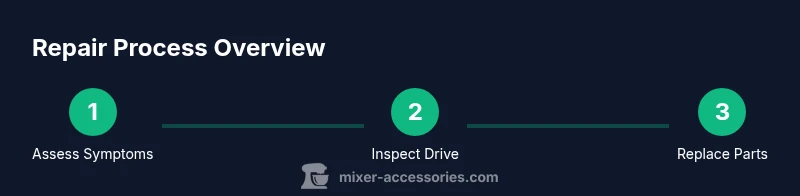
- Step 1: Unplug, detach attachments, and document symptoms.
- Step 2: Visually inspect for wear; check drive coupler and quick access areas.
- Step 3: Decide if the issue is a simple part swap or requires broader service.
- Step 4: Replace wear parts with model-appropriate components and reassemble.
- Step 5: Test at low speed, then gradually increase, watching for issues.
- Step 6: Schedule regular maintenance and keep records for warranty needs.
Tools & Materials
- Replacement drive coupler (model-specific)(Choose exact fit for your KitchenAid stand mixer model; inspect for cracks or deformation.)
- Replacement gears or gear housing (as needed)(Only replace with compatible gear set for your model; refer to parts list.)
- Replacement belt (if applicable)(Some models rely on a belt; verify belt type and length from the manual.)
- Phillips head screwdriver(Medium size; suitable for most fasteners.)
- Flathead screwdriver(For prying small covers where needed.)
- Allen wrench set(Hex sizes commonly 1.5–2.5 mm depending on model.)
- Electrical contact cleaner spray(Use only on approved contacts; ensure unplugged and dry before testing.)
- Multimeter (optional for electrical testing)(Only if you’re trained to diagnose circuits safely.)
- Small parts tray or labeled containers(Keeps screws and springs organized during disassembly.)
- Non-conductive lubricant (as specified by manual)(Only apply where the manual allows lubrication.)
Steps
Estimated time: 60-120 minutes
- 1
Unplug and prepare workspace
Ensure the mixer is unplugged and cool before handling. Clear a clean, well-lit workspace and lay out a parts tray. This initial safety step prevents electric shock and misplacement of fasteners.
Tip: Take a photo of each stage to help reassembly later. - 2
Remove attachments and access the head
Detach all attachments and lift the head according to your model’s manual. This exposes the drive area without exposing you to moving parts.
Tip: Keep screws in labeled containers and note their origin. - 3
Inspect drive coupler for wear
Visually inspect the coupler for cracks or deformation. Try gentle wiggling to detect looseness. A worn coupler is a frequent cause of loss of drive.
Tip: If you see fine cracking, replace immediately; don’t reuse. - 4
Check gears and housing for damage
Look for chipped teeth, excessive play, or lubricant buildup that could indicate wear. Do not force gears apart; use the manual as a guide.
Tip: Note any unusual grinding sounds when the gear is rotated by hand. - 5
Evaluate belt and pulleys (if applicable)
If your model uses a belt, inspect for cracks, fraying, or glazing. Replace with the exact-match belt and re-check pulley alignment.
Tip: Misaligned pulleys cause belt wear and poor performance. - 6
Replace worn parts as needed
Install the replacement parts carefully, ensuring proper seating and alignment. Avoid over-tightening screws which can strip threads.
Tip: Keep a record of the part numbers you used for future maintenance. - 7
Reassemble the drive assembly
Reverse the disassembly steps: reattach gears, coupler, and head. Reconnect all fasteners to factory torque specs.
Tip: Do a quick check for any loose components before test runs. - 8
Reconnect attachments and power
Attach the mixer head and accessories, then plug in to perform a low-load test. Confirm there are no obvious safety hazards.
Tip: Test with the bowl empty first to avoid mess. - 9
Initial low-speed test
Run the mixer at the lowest speed with no load or light batter to confirm smooth engagement. Listen for abnormal sounds or overheating during the test.
Tip: If something feels off, power down and recheck alignment. - 10
Final evaluation and cleanup
Increase speed gradually to a typical operating level and monitor for stability. Clean up work area and store tools properly.
Tip: Keep a simple maintenance log for future DIY repairs.
Your Questions Answered
What is the most common cause of a KitchenAid mixer failing to start?
The most common causes are worn drive couplers, loose attachments, or electrical faults in the power switch. Start with a visual check of the coupler and ensure the head is properly seated before pursuing deeper diagnostics.
The most common causes are worn drive couplers, loose attachments, or electrical faults in the power switch. Start with a visual check of the coupler and ensure the head is properly seated.
Can I fix a malfunctioning mixer while it’s still plugged in?
No. Always unplug the mixer before inspecting or disassembling any components. Working on live electrical equipment is dangerous and can cause shock or short circuits.
No. Always unplug the mixer before inspecting any components.
Are there safety warnings I should follow during disassembly?
Yes. Disconnect power, avoid liquids near electrical parts, and follow the manufacturer's manual for disassembly steps. If you see cracked housings or melted wiring, stop and seek professional help.
Yes. Always unplug first and follow the manual; stop if you see damage.
Which parts are most likely to wear out and need replacement?
Drive couplers are the most common wear parts in many KitchenAid models, followed by belts (if used) and internal gears. Check these first when diagnosing sluggish operation or loss of drive.
Drive couplers are the most common wear parts to check first.
When should I consider professional repair or warranty service?
If you encounter damaged wiring, cracked housings, or issues beyond basic part replacement, seek professional service. Warranty terms may also require authorized repair for coverage.
If you see wiring damage or a cracked housing, get professional help and check your warranty.
Watch Video
Top Takeaways
- Document symptoms before disassembly.
- Replace worn drive components to restore drive.
- Always follow model-specific torque specs during reassembly.
- Test at low speed before full operation.
- Know when to call a professional to avoid safety risks.