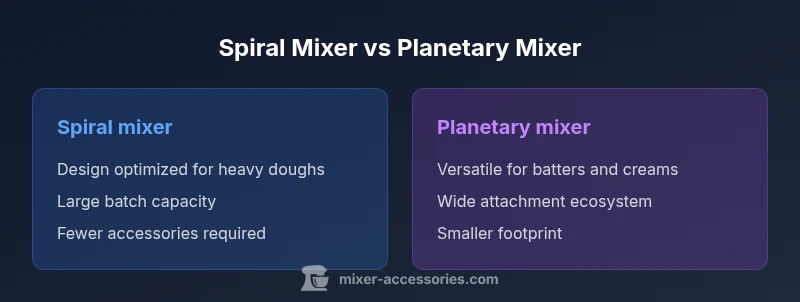
Spiral Mixer vs Planetary Mixer: A Practical Guide
Compare spiral mixers and planetary mixers to decide which suits bread dough, batters, and everyday baking. This analytical guide covers design, performance, and care for home cooks and hobbyists.


Both spiral mixers and planetary mixers serve distinct kitchen needs. In a spiral mixer vs planetary mixer comparison, the bottom line is dough type, batch size, and space. Spiral mixers develop gluten efficiently for heavy doughs and large batches, while planetary mixers excel at versatile batters and lighter doughs. The Mixer Accessories team notes that your choice should align with typical recipes and available workspace.
Overview: What spiral vs planetary mixers are and why the distinction matters
According to Mixer Accessories, understanding the fundamental difference between a spiral mixer vs planetary mixer helps you align equipment with your recipes, batch sizes, and workspace. A spiral mixer uses a stationary bowl with a single helical auger that moves through the dough when kneading. This design repeatedly folds and stretches gluten, producing consistent dough with low heat buildup and careful handling of large batches. A planetary mixer uses a set of beaters that rotate around the bowl in a planetary motion, delivering versatile mixing actions suitable for batters, creams, and lighter doughs. The distinction matters because it informs gluten development, air incorporation, and texture outcomes across bread, pastries, and cakes. For home cooks and hobbyists, choosing between the two means weighing typical recipes against space, noise, and maintenance considerations.
The spiral mixer is optimized for heavy doughs and high-volume production. If you bake bread daily, craft bagels, or knead stiff doughs regularly, a spiral model can deliver reliable gluten development with less manual effort. However, it tends to be less flexible for delicate batters and small batches. The planetary mixer, by contrast, offers broad versatility—from whipping cream to mixing cake batter and kneading small batches of dough. It handles a wide range of textures, but may require more careful timing and attachment changes for heavy dough work. In short, spiral vs planetary is less about which is “better” and more about which tool fits your recipe mix, batch size, and space constraints. The goal is to maximize consistency while minimizing wasted time and effort for your particular baking routine.
Spiral mixers: design, strengths, and limits
Design-wise, spiral mixers feature a stationary bowl and a center-driven spiral or ribbon auger that folds dough in a controlled kneading pattern. This geometry concentrates kneading action on gluten development, creating strong dough with excellent elasticity. The strengths of spiral mixers include efficient gluten development for large batches, gentle dough handling, and predictable texture across dense bread doughs. They excel when you routinely work with high-hydration doughs that require long knead cycles and consistent fermentation doughs. A notable limit is reduced versatility for light batters and quick-mix tasks where air incorporation and delicate mixing are essential. Cleaning can be more involved due to the enclosed mixing area and the spiral’s interaction with flour dust. In terms of workflow, spiral mixers typically demand a larger footprint and higher initial investment but offer lower energy use per unit of dough produced over time. For operators focused on consistent heavy dough outputs, spiral mixers often justify the space and cost with efficiency gains over long runs.
Operationally, pick a spiral mixer if your kitchen handles bread-focused recipes, bagel or pretzel production, or large-volume pizza dough. The model shines when batch size dwarfs other tasks and when gluten development needs to be controlled with reliable repeatability. Consider bowl sizes in the mid-to-large range and look for gear-driven stability, low heat generation, and easy access for cleaning. Attachments are usually limited to dough hooks and specialized kneading elements; plan around the dough type you intend to knead and how the equipment accommodates large, heavy loads. The result is a robust, bread-leaning machine that reduces manual kneading but keeps the door open for occasional complementary tasks with appropriate accessories.
Planetary mixers: design, strengths, and limits
Planetary mixers employ a beater (or paddle) attached to a motor that travels around the inside of the bowl in a planetary orbit, mixing ingredients evenly and incorporating air with gentle to moderate speed ranges. The strengths lie in versatility: you can whip, cream, whisk, blend, and knead. Planetary mixers shine for cake batters, meringues, cookie dough, and light bread doughs where fast, consistent mixing, and color and texture uniformity matter. They are generally easier to clean than spiral models and fit into smaller footprints, making them practical for home kitchens and small commercial setups. A limitation is that they may struggle with very heavy doughs or extremely large batches without disabling or limited bowl sizes. The bowl shape and beater geometry can lead to uneven gluten development for dense doughs if misapplied, and certain tasks (like prolonged kneading of strong doughs) may require switching to a spiral mixer or using a dedicated dough mixer. In summary, planetary mixers offer broad adaptability across a wide range of recipes, but their performance on heavy doughs often does not match a purpose-built spiral machine when batch size is large and texture control is critical.
Key performance metrics and recipe outcomes
To evaluate spiral vs planetary mixers, anchor your assessment to three core performance factors: gluten development efficiency, air incorporation, and batching capacity. Gluten development in spiral mixers tends to be highly efficient for bread doughs due to the continuous kneading motion that minimizes tearing and promotes uniform gluten networks. Planetary mixers excel at air incorporation for batters and creams, producing light textures in cakes and soufflés. When you compare batch capacity, spiral mixers generally support larger volumes of dough per run with less manual intervention, while planetary mixers excel in smaller, flexible batches and rapid task switching. Consider the heat produced during mixing, especially with heavy doughs; spiral mixers often stay cooler due to lower shear and better heat dissipation, while planetary models may generate more heat during intense kneading and long mixing times. Lastly, review maintenance considerations: spiral mixers have fewer attachment points and simpler kneading heads for heavy dough, whereas planetary mixers offer diverse attachments that expand functionality but require more routine cleaning between tasks.
Attachments, bowls, and scalability
Attachment ecosystems shape long-term versatility. Spiral mixers typically rely on dough hooks and spiral kneading elements designed for heavy doughs. They often use larger bowls, with bowl shapes optimized for dough engagement and uniform gluten development. Planetary mixers provide a broader attachment catalog—beater, whisk, paddle, and sometimes specialty attachments for emulsions, creams, and meringues. This versatility enables users to perform a wider range of culinary tasks without switching machines. Bowl shapes and sizes influence scalability: spiral models emphasize dough-focused capacity in mid-to-large bowls, while planetary models cover home-to-small-commercial ranges with various bowl volumes. When planning upgrades, assess compatibility with existing accessories and whether you’ll need to buy new attachments for expanded tasks. If your needs include bread-centric production and high-volume dough handling, a spiral mixer may be the most efficient choice; for a kitchen that values flexibility across batters, creams, and doughs, a planetary mixer offers the best balance.
Cleaning, maintenance, and durability considerations
Maintenance requirements hinge on design. Spiral mixers typically have fewer internal crevices and a more straightforward kneading assembly, which can simplify cleaning after heavy dough tasks. Routine lubrication and periodic drive-system checks help ensure long-term reliability in busy bakeries. Planetary mixers offer broader attachment use and more exposed beater paths, which can increase cleaning time but makes inspection and sanitization easier between tasks. Durable builds with quality gearboxes, seals, and motors are common in both types, but professional models may differ in service intervals and warranty terms. When choosing, factor in the frequency of use, the types of doughs you mix, and your facility’s sanitation standards. Regular inspection of drive belts (where applicable), motor heat, and gear wear will prolong life and maintain performance across both mixer styles.
Use-case scenarios: home baker, hobbyist, and small business
For a dedicated bread program in a small bakery, a spiral mixer can deliver superior dough development and batch consistency with lower labor input. Home bakers who primarily bake cakes, cookies, and pastries benefit from the planetary mixer’s flexibility and range of attachments, plus easier cleanup in a compact footprint. Catering setups and hobbyist micro-kitchens that require rapid switching between tasks—batter to dough to whipped cream—will find planetary mixers more adaptable. Small food businesses that plan to scale into bread production should weigh the initial capital against long-term batch efficiency. Spiral mixers represent a strong investment when large dough volumes and consistent kneading quality are non-negotiable; planetary mixers fit environments where variety, speed, and ease of use across multiple recipes drive daily workflow.
How to choose: a practical decision framework (spiral vs planetary)
Begin by defining your typical recipes: heavy doughs with high hydration and large batch sizes point toward a spiral mixer, while a broad range of batters, creams, and lighter doughs point toward a planetary mixer. Consider space: if you operate in a tight kitchen or café, a compact planetary model may be the practical choice. Budget and maintenance reality matter: spiral units often demand more upfront investment and larger footprints but offer efficiency on long runs; planetary units tend to be more affordable and flexible for diverse tasks. Finally, review long-term needs: a bread-focused operation benefits from the gluten-building efficiency of a spiral mixer, whereas a kitchen that values shortcut versatility will leverage planetary models for ongoing recipe variety. When in doubt, map your top 5 recipes by batch size and dough type, then compare against the expected throughput and maintenance footprint for each mixer type.
Comparison
| Feature | Spiral mixer | Planetary mixer |
|---|---|---|
| Mixing action | Stationary bowl with spiral kneading element for gluten development | Beaters orbit the bowl and mix ingredients with multiple textures |
| Ideal dough type | Heavy, high-gluten doughs (bread doughs, bagels, heavy pizza doughs) | Light to medium doughs and broad batter range (cakes, cookies, creams) |
| Capacity (bowl size range) | Mid-to-large dough batches; larger bowls common | Wide range from home to small-commercial bowls |
| Speeds and range | Fewer, kneading-focused speeds | Many speeds for whipping, creaming, and kneading |
| Attachments | Typically dough hooks; limited additional tasks | Beater/whisk/paddle plus optional specialized attachments |
| Cleaning and maintenance | Typically straightforward; fewer attachment points | More attachments increase cleaning steps; versatile but requires care |
| Noise and energy | Often robust but efficient with large loads | Can be louder during heavy tasks; flexible operation |
| Price range | Higher upfront cost for professional-grade models | Lower to mid-range pricing for versatile home units |
| Best for | Dedicated bread production, large batches | Versatile baking tasks, smaller to medium batches |
The Good
- Excellent gluten development for heavy doughs and large batches
- High-capacity models reduce manual kneading time
- Durable build and long-term reliability in busy bakeries
- Broad attachment ecosystem in planetary units expands task range
- Balanced performance for repetitive dough tasks and diverse recipes
Negatives
- Higher upfront cost and larger footprint for spiral models
- Less flexible for delicate batters and small batches (spiral)
- More maintenance workload with multiple attachments (planetary)
- Planetary models may struggle with very heavy doughs without larger bowls
Spiral mixers excel for heavy doughs and large batches; planetary mixers win on versatility and space-conscious setups.
Choose a spiral mixer if your focus is robust dough development and high-volume bread production. Opt for a planetary mixer when you need broad recipe flexibility, easier cleanup, and a smaller footprint.
Your Questions Answered
What is the main difference in mixing action between spiral and planetary mixers?
Spiral mixers use a stationary bowl with a spiral kneading element that pushes dough against the bowl walls, promoting gluten development in heavy doughs. Planetary mixers use beaters that travel in a planetary orbit, providing versatile mixing and better air incorporation for light batters and creams.
Spiral mixers knead by pulling dough along the bowl; planetary mixers mix by rotating around the bowl, great for many tasks.
Are spiral mixers suitable for cake batters?
Spiral mixers are not ideal for delicate cake batters or meringues. Their kneading action can overwork softer doughs and gluten-free batters, whereas planetary mixers are better suited for whisking, beating, and folding in ingredients.
They’re not the best choice for cakes; planetary mixers handle batters and creams better.
Can I upgrade attachments to planetary mixers?
Planetary mixers support a wide range of attachments (beaters, whisks, paddles) and can be expanded with specialty add-ons. If you start with a planetary model, you’ll gain versatility for many recipes, but you may still need a separate dough mixer for heavy doughs.
You can add different attachments to planetary mixers for more tasks.
Which is better for a small home kitchen?
For a small home kitchen, a planetary mixer is typically the better fit due to its compact footprint, broad task range, and simpler cleaning. Spiral mixers are great for bread-focused hobbyists with more space and a consistent bread workflow.
Planetary mixers usually fit small kitchens best, thanks to versatility and size.
Are spiral mixers noisy?
Noise levels vary by model, but spiral mixers can be louder during heavy kneading due to powerful gearboxes. Modern units often include sound-dampening features. Consider the noise profile alongside placement and use hours.
They can be louder during heavy kneading, depending on the model.
What maintenance do these mixers require?
Regular maintenance includes checking drive belts or gears, lubrication where applicable, and cleaning to prevent dough buildup. Follow the manufacturer’s service intervals and sanitize between uses to maintain performance and hygiene.
Keep up with routine checks and sanitation for best results.
Top Takeaways
- Evaluate your typical doughs before buying
- Choose spiral for heavy doughs and large batches
- Choose planetary for versatile tasks and smaller spaces
- Assess space, maintenance, and attachment needs
- Aim for equipment that matches your top 5 recipes