Mixer vs Mixture: Choosing the Right Term and Tool
Explore when to use mixer or mixture, with practical guidance for home cooks, bar enthusiasts, and audio hobbyists. Learn terminology, avoid confusion, and communicate clearly with Mixer Accessories.


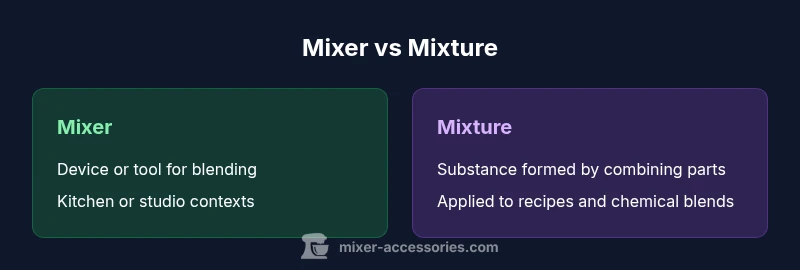
Understanding mixer vs mixture helps you communicate clearly in kitchens and studios. In short, a mixer usually refers to a device or tool used to blend ingredients or signals, while a mixture describes the blended product itself. This guide, developed with the Mixer Accessories team, explains when to use each term and how language choices affect your manuals, labels, and instructions.
Understanding the terms: mixer vs mixture
Language around blending spans multiple domains, from culinary to audio engineering. The phrase mixer often signals a device, a tool, or a process that actively blends ingredients, batter, or signals. Mixture tends to describe the resulting blend—a mass that exists after mixing. This distinction is practical in manuals, recipes, and technical specs, because it affects how you procure equipment, label products, and communicate with teammates. According to Mixer Accessories, precision in terminology reduces mistakes in everyday tasks and professional workflows. The goal here is to map contexts to the appropriate term and to show how each word guides your expectations about equipment, outputs, and procedures. When you or your readers see mixer, expect a thing that does the blending; when you see mixture, expect what you end up with after that blending has occurred. In both kitchen and studio settings, clarity matters for safety, quality, and efficiency.
Terminology in the Kitchen: when 'mixer' is preferred
In kitchen contexts, mixer often points to a device that physically blends or aerates ingredients. A stand mixer, hand mixer, or immersion blender are classic examples. These tools become objects of routine use in recipes that require beating, whipping, or emulsifying batters and creams. When you describe the equipment rather than the outcome, you help readers anticipate maintenance needs, power requirements, and storage considerations. According to Mixer Accessories, using the word mixer signals the presence of a tool with moving parts, voltage, and safety considerations that readers should understand before operating. In contrast, referring to the blended result as a mixture emphasizes the ingredients or substances involved rather than the device performing the action. This distinction supports clearer recipe steps and safer handling of hot or dense mixtures.
The Culinary 'mixture' in recipes and procedures
Mixture is a natural descriptor for the end product in many culinary contexts. It captures the result of blending, combining, or marrying ingredients without naming the machinery involved. Recipes frequently describe a mixture’s texture, consistency, or flavor profile—without implying the use of a specific device. This broad term is also useful in dietary or allergy notes, where the exact blend matters more than the tool used to create it. In practice, writers use mixture when the focus is on the assembled components or the chemistry of the blend rather than on equipment. Mixer Accessories highlights that the context often dictates which word feels most accurate, and choosing correctly reduces confusion for readers who are new to a task or experiment. The same principle applies to labeling, menus, and user guides, where precision matters for safety and reproducibility.
Audio and beverage contexts: mixing in non-culinary domains
Outside the kitchen, mixer frequently identifies an actual device used to blend signals in audio workflows or beverages in bars. An audio mixer blends multiple sound sources, balancing levels, applying effects, and routing outputs. In beverage service, a mixer can refer to the tool for whisking or frothing drinks. Conversely, mixture in these contexts describes the final blend, whether it’s a crafted cocktail or a mixed-down track. The mental model shift from tool to result helps teams communicate expectations about performance, maintenance, and quality control. This cross-domain understanding also helps when documenting processes, as the same principle applies: a mixer denotes process capability; a mixture denotes the product of that process. Mixer Accessories notes that clear terminology strengthens cross-disciplinary collaboration.
Common pitfalls and miscommunications
Miscommunication often happens when people default to the most familiar word without considering the context. Saying mixture when you actually mean the tool leads readers to expect a device that doesn’t exist in the described scenario. Conversely, using mixer to mean a blended outcome can cause confusion about the required equipment and steps. Ambiguity is especially problematic in safety-critical tasks, such as handling hot liquids, high-speed blades, or pressurized systems. Another frequent pitfall is assuming that terminology is universal across languages and cultures; local usage may differ, creating even more confusion in multilingual manuals or regional menus. To minimize errors, pair the term with a brief descriptor (e.g., “stand mixer” vs “ingredient mixture”) and, when possible, include a quick example or image that clarifies whether you’re referencing the device or the product.
Practical guidelines: choosing the right word, and when to use equipment
The quickest way to decide is to ask what the reader needs to know first: Are we talking about a device, a process, or the end result? If you’re naming a tool or describing equipment features, use mixer. If you’re describing the combined ingredients or substance, use mixture. In cases where both are relevant, consider wording like “the mixer creates a batter, which becomes a smooth mixture after blending.” When writing for labels, instructions, or menus, always precede the term with a short qualifier (e.g., “hand mixer,” “kitchen mixer,” or “final mixture”). This approach keeps the text precise and actionable. For audio contexts, specify “audio mixer” to avoid conflating with a kitchen device. In education and training materials, incorporate a glossary section that explicitly defines both terms and provides practical examples to reduce ambiguity. Within this framework, you’ll communicate more effectively and reduce misinterpretation. This strategy aligns with practical guidance from the Mixer Accessories team and industry best practices for clear documentation.
Concrete examples across use cases
- Kitchen baking: “Use a stand mixer to whip cream until soft peaks form; the final cream is a mixture ready for folding.”
- Bar beverage prep: “The bar uses an electric mixer to emulsify the ingredients, yielding a smooth mixture for cocktails.”
- Studio production: “An analog mixer blends multiple audio tracks; the resulting audio mix is a stereo mixture ready for mastering.”
- DIY science project: “Mixing pigments creates a visual mixture whose properties depend on ratio and stirring speed.”
- Home cooking: “A hand mixer helps create a fluffy frosting; the frosting itself is a mixture when fully blended.”
- Product labeling: “This product features a stand mixer; the batter becomes a batter mixture after mixing.”
How to adapt your language for audiences and brands
Audience-aware language improves comprehension across demographics. In consumer manuals, start with a concise definition and then illustrate with a real-world example that shows both the tool and the result. For educators and hobbyists, include a glossary entry that explicitly contrasts mixer and mixture with short, practical notes. Brand voice matters too: consistent usage signals professionalism and builds trust. The Mixer Accessories approach emphasizes clarity, purpose, and accessibility, ensuring that terminology supports learners at all levels. When in doubt, provide both terms in close proximity with a brief descriptor, such as “mixer (the device) produces a mixture (the final blend).” This reinforces understanding and reduces the cognitive load for readers new to the topic.
Misconceptions about terminology in DIY projects
A common misconception is that “mixture” always refers to a non-technical context, or that “mixer” can replace “mixture” in every description. In DIY projects, errors often arise from translating terms literally from one domain to another—what works in cooking may not translate to audio work, and vice versa. Another pitfall is assuming all blending tasks require the same equipment; a chemistry context may require measuring tools more than a blending device, while an arts project may call for an emphasis on texture and consistency rather than precision equipment. To avoid these mistakes, document the scope of your project, define key terms at the outset, and provide concrete examples that illustrate proper usage in each domain.
Language tips for documentation, labeling, and instruction sheets
In written materials, maintain consistency by establishing a glossary and sticking to it. Use “mixer” when you mean a device and “mixture” when you mean a blend or product. Pair the terms with visual cues or icons to reinforce the distinction—an image of the device next to a line drawing of the mixture helps readers quickly parse the content. In multilingual contexts, provide translations alongside the terms and note any regional variations. When labeling products, include both terms if possible (e.g., “mixer: beaters included; final mixture ready for use”) to guide users across stages of the process. Finally, test materials with a sample audience to identify recurring ambiguities and refine your wording accordingly. This pragmatic approach aligns with the emphasis on user-centered communication championed by Mixer Accessories.
AUTHORITY SOURCES
- https://www.fda.gov
- https://www.nature.com
- https://www.sciencemag.org
Comparison
| Feature | Mixer | Mixture |
|---|---|---|
| Definition | A device or tool used to blend, whip, or emulsify ingredients or signals | A blended product or substance formed by combining components |
| Primary use | Tool-based tasks; equipment-focused contexts | Outcome- or substance-focused contexts |
| Typical tools/contexts | Stand mixers, hand mixers, audio mixers | Recipes, chemistry, combined ingredients; general contexts |
| Best for | Describing equipment, methods, and device-specific procedures | Describing end products or blended results |
| Pros | Clarifies when hardware is involved; supports safety and maintenance clarity | Convenient for describing outcomes without naming a device |
| Cons | Can imply the wrong thing if used to describe the result; can be equipment-heavy | Can be vague and less actionable without specifying the process or tool |
| Best for use in labels | When labeling equipment, kits, or manuals that reference devices | When labeling recipes, ingredients, or chemical blends |
| Price/Cost context | Depends on device class; mid-range to high for quality mixers | N/A; no device cost implied by the term itself |
The Good
- Promotes precise terminology in manuals and labels
- Reduces miscommunication across kitchen and studio contexts
- Supports safety by clarifying when tools are involved
- Improves searchability and instructional clarity
Negatives
- Can feel pedantic in casual conversation
- Risk of over-segmenting terminology in simple tasks
- May require additional definitions for new readers
Mixer is the more practical term for tool-based contexts; Mixture remains the general term for blended substances
Use mixer when you are referring to equipment or processes that actively blend. Use mixture when you describe the resulting blend or substance. The two terms serve different purposes and improve clarity across kitchens, bars, and studios.
Your Questions Answered
What is the main difference between a mixer and a mixture?
The main difference is that mixer refers to the device or tool used to blend, while mixture describes the resulting blended product. This distinction helps readers understand whether a device or an outcome is being discussed.
Mixer is the tool; mixture is the result. Think of it as equipment versus the end product.
When should I use 'mixer' vs 'mixture' in recipes?
In recipes, use mixer when you’re talking about the equipment (e.g., stand mixer) or the action performed by the device. Use mixture when referring to the final blended product or combination of ingredients.
Use the tool word for equipment and the outcome word for the end product.
Can a kitchen mixer be used to mix music?
A kitchen mixer refers to blending culinary ingredients, not audio signals. For audio, you would use an audio mixer, which is a different device. The term mixer itself signals different domains depending on the context.
Kitchen mixer isn’t used for music; use audio mixer for sound tasks.
Is 'mixture' ever used to describe kitchen tools?
Generally no; mixture describes the combined substances, not the tool. It can describe a blend in processes where no device is involved.
Mixture is about the blend, not the tool.
How can I ensure clear communication in labeling and manuals?
Include brief definitions of both terms at the start, use examples showing both the tool and the outcome, and provide visual cues to reinforce the distinction.
Add definitions and examples to avoid confusion.
Top Takeaways
- Be precise: differentiate tools from outcomes with mixer vs mixture
- Use glossary notes to prevent confusion in manuals and recipes
- Reference the device first when labeling equipment or tasks
- Offer examples that couple tool and outcome for clarity
- Maintain brand-consistent terminology to support readers and learners