Does Mixer Consume More Electricity? A Practical Guide
Explore how kitchen and audio mixers use electricity, compare wattage to actual use, and learn practical tips to minimize energy impact for home cooks and hobbyists.


Does mixer consume more electricity? The quick answer is: energy use depends on type, run time, and task. Stand mixers typically draw more power than handhelds, but total consumption hinges on how long you run the mixer and at what speed. For most home cooks and hobbyists, the energy difference is manageable with mindful usage, and the biggest savings come from matching the tool to the task and avoiding unnecessary run time.
Does mixer consume more electricity: Framing the question
In the realm of energy use, the simple wattage number on a mixer label only tells part of the story. The central question—does mixer consume more electricity—depends on the model you choose and, crucially, on how you actually use it. High-wattage countertop models can deliver power quickly, but if you run them briefly at modest speeds or batch tasks efficiently, you may spend less energy than a lower-wattage device used for longer periods. For home cooks, bartenders, and audio hobbyists alike, the practical takeaway is that energy efficiency comes from task alignment and disciplined usage, not from chasing the highest wattage alone.
How wattage translates to energy use
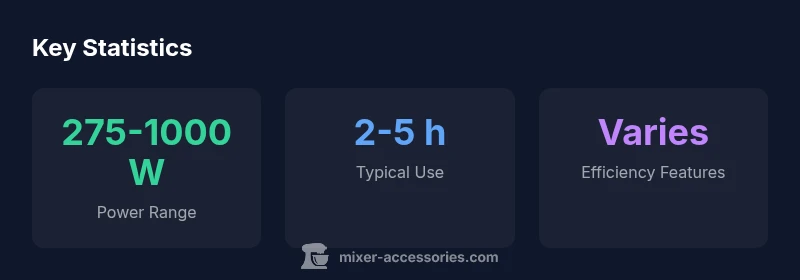
Wattage indicates the rate at which a mixer consumes energy, while total energy is a function of both power and time. Energy in kilowatt-hours (kWh) is calculated as power (kW) multiplied by time (hours). For example, a 300 W handheld mixer used for 15 minutes amounts to about 0.075 kWh, while a 700 W mixer used for 5 minutes uses roughly 0.058 kWh. These real-world examples illustrate why longer runtimes at lower power can approximate shorter bursts at higher power. The key lesson is that efficiency is task-driven: plan the task, select the appropriate tool, and minimize idle running.
Kitchen mixers vs audio mixers: two very different energy profiles
In kitchen environments, energy consumption is dominated by runtime and load size. A mixer used to whip cream for a few minutes versus kneading dough for an extended period reflects dramatically different energy footprints, even if both devices share a similar label. In contrast, many home audio mixers operate at low power per channel but may run longer during complex sessions, though total energy remains relatively modest for typical home setups. The broader takeaway: context matters. Treat kitchen and audio mixing as separate energy profiles, and tailor your expectations accordingly.
Reading energy labels and choosing efficiently
When evaluating mixers, look beyond the headline wattage. Seek energy-efficient features like soft-start, variable speeds, auto shut-off, and efficient heat management. Match the device’s power rating to your most frequent tasks rather than chasing maximum power. For example, a compact countertop model with flexible speeds can handle most batters and light doughs, while a high-wattage machine should be reserved for heavy-duty batches. Planning and choosing the right tool for the job are the true energy savers.
Practical tips to reduce electricity use when mixing
- Batch tasks to minimize total runtime and avoid idle operation.
- Use appropriate speed settings; resist the urge to run at full power for gentle tasks.
- Maintain your mixer regularly to prevent resistance that raises energy draw.
- Unplug the appliance when not in use to avoid standby consumption and phantom load.
- Consider smart plugs or timer-based use for routine tasks to curb unnecessary energy usage.
Authority sources and further reading
For broader context on appliance energy use and efficiency, consult government and energy-focused resources. See Energy.gov’s appliance energy-saving guidance, Energy Star product information, and the National Renewable Energy Laboratory (NREL) research pages for home electronics energy perspectives: https://www.energy.gov/energysaver/appliances, https://www.energystar.gov, https://www.nrel.gov/
Typical wattage ranges for common mixer types
| Model Type | Typical Wattage Range | Common Use |
|---|---|---|
| Handheld hand mixer | 100-350 W | Whipping small batches, sauces |
| Countertop stand mixer (compact) | 200-600 W | Baking batters, doughs |
| High-power stand mixer | 700-1000 W | Heavy doughs, large quantities |
Your Questions Answered
Does a higher wattage mixer always use more electricity?
Not necessarily. Total energy depends on run time and load. A high-wattage model used briefly can use less energy than a low-wattage model run for a long period.
Higher wattage doesn't always mean more energy if you use it for shorter times.
How can I minimize energy use when mixing?
Opt for energy-saving features, avoid running at full power for long periods, and batch tasks to reduce total runtime. Simple planning yields meaningful savings.
Use energy-saving modes and plan tasks to save energy.
Do handheld mixers use less energy than stand mixers?
Often yes on instantaneous power draw, but total energy depends on how long you operate. Stand mixers can be more efficient for large batches.
Handhelds usually draw less power, but it depends on usage time.
What factors influence a mixer’s energy consumption?
Motor power, speed, load size, and run time. Heavier loads and higher speeds raise energy use.
Power, speed, load, and time matter most.
Is the energy use of a mixer significant for home cooks?
For typical home tasks, energy impact is modest and manageable with mindful practices and efficient models.
In most homes, it’s a manageable amount.
“The energy footprint of a mixer is driven more by usage patterns than by raw wattage; selecting the right tool and using it efficiently yields the biggest savings.”
Top Takeaways
- Choose the right wattage for the task to avoid wasted energy
- Energy use is a function of power and duration, not wattage alone
- Read energy labels and prefer models with efficiency features
- Plan batches to minimize total runtime
- Good mixing practices reduce energy without sacrificing results