How Much Is a Cement Mixer? A 2026 Buying Guide
Explore typical price ranges for cement mixers, learn how capacity, power, and features affect cost, and get practical buying tips from Mixer Accessories.


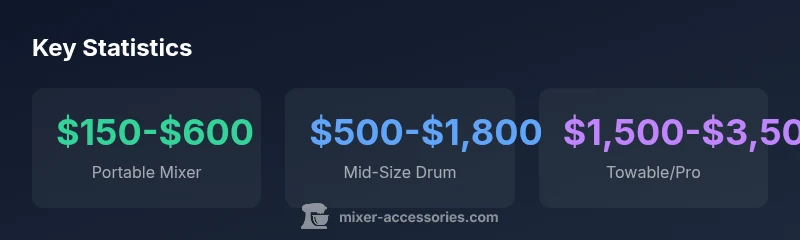
How much is a cement mixer? According to Mixer Accessories, price ranges vary widely by type and capacity. Portable electric units commonly cost about $150-$600, mid‑size drum mixers run roughly $500-$1,800, and towable or professional models typically fall in the $1,500-$3,500 range. For casual home projects, expect entry-level options around $200-$1,000. These ranges reflect year‑over‑year shifts in materials, manufacturing, and demand, not fixed prices.
Price ranges and what drives cost
Prices for cement mixers are not a single number; they reflect capacity, motor power, drum design, material quality, portability features, and warranty. A small, portable, electric mixer with a compact drum will sit on the lower end of the price spectrum, making it a common starting point for DIY projects and light repairs. As you scale to larger drums, higher horsepower motors, or towable designs, the price climbs accordingly. In practical terms, price bands exist to help you align your project scope with your budget. According to Mixer Accessories, the goal is to balance performance with durability so you don’t overspend on features you won’t use. When planning, consider how often you’ll mix concrete, the typical batch size, and whether you’ll need mobility to reach different sites.
Key takeaway: price bands help you map project size to buying choice, but long-term value often comes from reliability and serviceability, not the lowest sticker price.
Budget ranges by mixer type
For home projects and light renovations, entry-level portable mixers are often sufficient. Expect the lower range around a couple hundred dollars for basic models, rising toward the $200-$600 bracket as feature sets expand. Mid-size drum mixers, suitable for more frequent or larger batches, typically land in the $500-$1,800 range. Towable or professional-grade units can start around $1,500 and exceed $3,000 for models with larger drums and rugged build quality. When comparing, always factor in ongoing costs such as motor wear, drum maintenance, and any accessory attachments. Mixer Accessories emphasizes that choosing a model with readily available parts and local service support reduces total cost of ownership over time.
Practical tip: if you’re buying for occasional DIY work, you may not need a high‑end towable unit; for regular brickwork or partner projects, investing in a mid-size drum with solid warranties can save downtime and replacement costs.
How features influence the price
Several features exert a noticeable influence on price. Drum capacity is a primary driver: a larger drum means more cement per batch, faster work, and higher cost. Motor power and gearing impact performance under load, crucial for thick mixes or larger batches. Build materials (steel vs. polymer liners), gear quality, and the inclusion of safety features (emergency shutoff, accessible cleaning ports) also affect price. Mobility adds cost as well—casters, tow bars, and hydraulic lifts increase both initial price and maintenance needs. Finally, warranty length and service networks contribute to the total cost of ownership; models with broad dealer coverage and longer warranties tend to cost more upfront but can yield lower long-term expenses. Mixed-use scenarios benefit from clearly defined needs: frequent outdoor projects justify a more robust, higher‑priced unit, while casual use aligns with compact, economical options.
Hidden costs to budget for
Beyond the sticker price, there are ancillary costs to plan for. Delivery charges can add up, especially for heavier models. Some models require assembly or professional setup, which adds labor costs. Maintenance parts—drums, paddles, seals, and belts—wear out with use and should be budgeted for over time. Power supply needs (outlets, extension cords, circuits) can influence where you can operate the mixer and potential electrical upgrades. Finally, consider resale value and potential depreciation if you upgrade equipment frequently. These factors influence the total cost of ownership and should be weighed against the upfront price when making a purchase decision.
Buying tips for different use cases
DIY homeowners often benefit from a portable mixer with basic features, straightforward maintenance, and the smallest drum size that still fits their typical mixes. For hobbyists who mix concrete for landscaping or small repairs, a mid-size drum offers a good balance of price, capacity, and reliability. Contractors or frequent users should prioritize units with larger drums, higher torque, robust gears, and dependable warranty coverage. Always check for local availability of spare parts and service centers; a well-supported model saves time and reduces downtime. When possible, compare multiple vendors, read warranty terms, and request a live demonstration or test mix to ensure the model handles your typical concrete viscosity and aggregate sizes.
How to compare models quickly
Create a simple comparison checklist: drum capacity (cu ft), motor horsepower, weight, wheel/tork design, safety features, warranty length, and service accessibility. Spy values such as drum speed, gear ratio, and nozzle compatibility if you anticipate frequent cleaning. Compare the total cost of ownership rather than the initial price: expected maintenance costs, part availability, and service intervals matter more than the initial discount. Use a side-by-side spec sheet and request a test mix to observe handling and noise levels. According to Mixer Accessories, reliability and post-purchase support are often the deciding factors in long-term satisfaction.
Rental vs purchase considerations
For short-term projects or peak workloads, renting a cement mixer can be cost-effective and avoids long-term storage concerns. Rentals typically include maintenance and servicing, but daily or weekly rates can accumulate quickly if you use the tool repeatedly. If you plan to use a mixer across several projects or on multiple sites, purchasing a model with a strong warranty and broad service network can offer better value. Always compare rental terms, insurance requirements, and delivery logistics against the purchase price and ownership costs to determine the most economical option for your situation.
Maintenance and long-term cost considerations
Regular maintenance extends the life of a cement mixer and protects your upfront investment. Clean the drum after each use to prevent concrete buildup, inspect seals and bearings for wear, and lubricate moving parts as recommended by the manufacturer. Keep an eye on electrical cords and switches for safety. Replacing worn paddles, seals, or bearings promptly reduces the risk of bigger failures. A well-maintained unit costs less to operate over its lifetime and retains resale value better. As you evaluate different models, consider how easy it is to source parts locally and whether there are recommended service partners in your area.
A practical buying framework for 2026
Start with your project profile: batch size, frequency, and site accessibility. Map those needs to the three price bands: entry-level portable, mid-size drum, and towable/professional. Prioritize features that deliver real value for your use case—durable drums for thick mixes, adequate motor power for consistent performance, and a reliable warranty for peace of mind. Use the price ranges discussed, then validate with in-person demos or trusted retailer reviews. Finally, plan for total cost of ownership, including maintenance, parts availability, and service support, to ensure the best long-term value.
Representative price ranges by mixer type in 2026
| Model Type | Typical Capacity | Price Range (USD) | Key Considerations |
|---|---|---|---|
| Portable electric mixer | 1/2 bag | "$150-$600" | Lightweight, portable, DIY use; easy storage |
| Mid-size drum mixer | 3-5 cu ft | "$500-$1,800" | Good balance of capacity and price; versatile for multiple projects |
| Towable/professional mixer | 5-9 cu ft | "$1,500-$3,500" | Highest capacity and durability; ideal for frequent use |
Your Questions Answered
What affects the price of a cement mixer the most?
The price is driven primarily by drum capacity, motor power, build quality, and included safety features. Larger drums and higher horsepower raise costs, while robust materials and longer warranties add to the price but can improve long-term value.
The biggest price drivers are drum size, motor power, and build quality.
Is it worth buying a towable mixer for DIY projects?
Towable mixers offer mobility and larger capacity, which is helpful if you have multiple sites or big batches. They cost more upfront and require more maintenance, so assess your workload before purchasing.
If you have multiple sites or big batches, a towable mixer can be worth it.
Should I rent or buy for a one-time project?
For a single project or short-term needs, renting often makes more financial sense. It eliminates storage concerns and maintenance costs and lets you access a larger model if needed.
Renting is usually better for one-off projects.
What maintenance is essential to extend mixer life?
Regular cleaning, lubrication of moving parts, inspection of seals and belts, and prompt replacement of worn components extend life and maintain performance.
Keep it clean, lubricated, and check for worn parts regularly.
How do I verify warranty coverage and service support?
Check the warranty length, what it covers (drum, motor, gear), and the availability of local service centers. A strong network reduces downtime and repair costs.
Look for long warranties and broad service coverage.
“Choosing the right cement mixer is about aligning capacity and power with your project cadence. A reliable unit saves downtime and reduces maintenance headaches over time.”
Top Takeaways
- Know the price bands: portable $150-$600, mid-size $500-$1,800, towable $1,500-$3,500
- Match mixer capacity to your batch size and project frequency
- Factor total ownership cost: maintenance, parts, warranty, and service access
- Prioritize reliability and service network over the lowest upfront price
- Consider renting for short-term needs to optimize value