Difference Between Mixer and Thermostatic Shower: A Practical Guide
Explore the difference between mixer taps and thermostatic showers for home bathrooms. Get safety, maintenance, and selection tips from Mixer Accessories to inform your next upgrade.


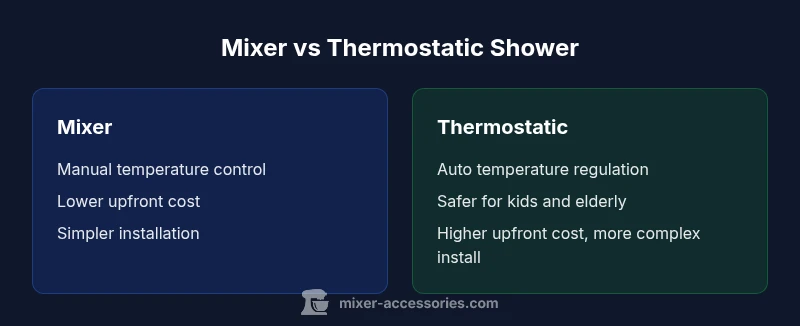
At a glance, a mixer tap blends hot and cold water manually, while a thermostatic shower uses a sensor to maintain a stable output temperature. The choice hinges on safety priorities, installation context, and budget; thermostatic showers provide safer, consistent temperatures, whereas mixers tend to be cheaper and easier to install.
The core concepts: what's in a mixer vs thermostatic shower?
In modern bathrooms, you will encounter two common options for controlling water temperature: mixer taps and thermostatic showers. Although both deliver warm water for showering or washing, they regulate temperature in fundamentally different ways. The difference between mixer and thermostatic shower is not just a technical footnote—it influences safety, comfort, and long-term cost. According to Mixer Accessories, understanding these core concepts helps homeowners and professionals pick fixtures that align with usage patterns, water supply, and budget. In practice, you think of a mixer as a manual valve that blends hot and cold water to reach your desired temperature, while a thermostatic valve uses sensors and a calibrated cartridge to hold the temperature steady even if supply pressure or temperature fluctuates. That distinction cascades into how you install, maintain, and price these fixtures. The reader should keep in mind that the term “thermostatic” is not a universal guarantee of safety, but rather a feature that stabilizes warmth, typically with a safety stop around a set maximum.
How temperature control actually works in practice
The hardware inside each system is designed to respond to different inputs. A standard mixer tap relies on manual balancing: turning a single lever or two separate handles adjusts hot and cold flow to achieve a comfortable mixed temperature. But this means any fluctuation in incoming water temperature or pressure can cause the output to drift. A thermostatic shower valve, by contrast, uses a sensor (usually a wax or bimetal element) that detects temperature and adjusts the hot and cold in real time to keep the set temperature stable. The difference between mixer and thermostatic shower becomes most apparent during water pressure changes, such as when another fixture turns on or a water heater cycles on. In such cases, a thermostatic unit may maintain a safer, more predictable temperature, reducing shock and scald risk. For households with children or elderly users, thermostatic valves with a maximum temperature stop add an extra layer of protection. The trade-off is that thermostatic systems are more complex and often require a more deliberate installation plan.
Safety, reliability, and everyday scenarios
Safety is often the deciding factor. The difference between mixer and thermostatic shower is not solely about comfort; it directly impacts how you manage scald risk in busy mornings or after a shower with a long run of hot water. The thermostatic option is designed to limit maximum temperature automatically, which reduces sudden spikes if someone opens a hot tap elsewhere, or if cold water pressure drops. From a reliability perspective, thermostatic valves have cartridges that are designed for long service life and more predictable performance, though they may need periodic cartridge replacement. For a busy kitchen or bar area where someone might run water at different temperatures while you’re cleaning, you will likely appreciate the safety margins of thermostatic control. Mixer taps, especially in older homes, can be perfectly adequate where water pressure is stable and the household is comfortable balancing temperature manually. The key takeaway is that the difference between mixer and thermostatic shower is most meaningful when you consider safety requirements, occupant age, and water-supply dynamics, rather than aesthetics alone.
Installation, plumbing compatibility, and upkeep
The installation differences are practical. A mixer typically requires fewer parts behind the wall and may be easier to retrofit into existing plumbing. A thermostatic shower valve demands a more robust installation, with precise temperature balancing and a separate heat sensor unit. Space behind walls matters; thermostatic units often require additional space and accessible cartridge replacement. Maintenance wise, a mixer may cause fewer moving parts and thus less frequent service, but you must recalibrate if the incoming water balance shifts. Thermostatic valves, while more maintenance-intensive, reap rewards in safety and consistent performance. When selecting fixtures, check compatibility with your water heater type, supply pressures, and existing pipe layout. The difference between mixer and thermostatic shower often becomes most clear during upgrade projects or bathroom renovations, where the available space, insulation, and local building codes influence the decision. A note from the Mixer Accessories team emphasizes planning ahead to avoid later retrofit costs. These considerations should guide you toward fixtures that harmonize with your home's plumbing architecture.
Cost, value, and long-term considerations
In the realm of cost, the difference between mixer and thermostatic shower is not solely about purchase price; it includes installation labor, potential retrofits, and ongoing maintenance. A typical mixer setup is cheaper upfront and may suit a straightforward renovation. Thermostatic valves, while pricier initially, can reduce energy use by preventing temperature overshoots, and may offer longer-term savings through less temperature instability and reduced scald incidents. However, the added components in thermostatic systems can raise replacement part costs and complicate DIY projects. If your project involves small bathrooms with tight spaces, you may find mixer options easier to fit; if you need precise control in family households, thermostatic models can justify the extra cost. As with any investment in home infrastructure, weigh the total cost of ownership: initial price, installation complexity, expected lifespan, and the potential for energy savings. The Mixer Accessories analysis indicates that homeowners who prioritize safety and consistent temperature often lean toward thermostatic solutions, whereas those focused on budget and simplicity lean toward mixers.
Room-by-room decision guidance: kitchen vs bathroom
While this article focuses on showers, many readers will translate the principles to kitchen fixtures as well. The broad difference between mixer and thermostatic shower extends to sinks and prep areas where you want to control hot water precisely. In bathrooms, thermostatic control excels in family homes, clinics, or rentals with peak demand variations. In kitchens or bar areas, a trusted mixer tap can be perfectly adequate when used with a robust water heater and stable supply. For hobbyists and enthusiasts who enjoy hands-on tinkering, the ability to fine-tune flow at the tap offers an ease-of-use advantage. If you expect irregular hot-water supply due to older plumbing or long runs from a water heater, thermostatic mixing valves can offer stabilization that helps prevent scalding. If you prefer straightforward upgrades with minimal disruption, a standard mixer is often preferred. The Mixer Accessories team notes that a careful assessment of use, age of occupants, and water pressure will yield the best long-term experience.
Practical next steps
To move from theory to action, start with a quick assessment of your current water pressure stability, child or elderly household safety concerns, and the scope of your planned upgrade. Use the difference between mixer and thermostatic shower as a decision framework: safety and consistency favor thermostatic solutions; budget and retrofit simplicity favor mixers. Gather quotes that itemize installation labor, required valves, and potential future maintenance costs. Finally, consult reputable sources such as government safety guidelines and major publications to ensure your choice aligns with local codes and best practices.
Comparison
| Feature | standard mixer tap | thermostatic shower valve |
|---|---|---|
| Temperature control method | manual balancing of hot/cold | thermostatic feedback with auto-regulation |
| Safety features | no built-in safety stop (depends on model) | maximum temperature stop and sensor-based control |
| Installation complexity | simpler, fewer components behind wall | more complex, dedicated valve unit |
| Maintenance needs | fewer moving parts, basic upkeep | cartridge replacement and sensor calibration occasionally required |
| Ideal water pressure compatibility | works across typical residential pressures with manual balance | holds stable temperature under pressure fluctuations |
| Best for | budget refurbishments, DIY-friendly projects | safety-focused homes, families with kids or elderly |
The Good
- Lower upfront cost and simpler installation
- Familiar operation for long-time users
- Broad compatibility with existing plumbing and fixtures
- Easier to source parts and repairs
Negatives
- Thermostatic models offer safer, temperature-stable performance but cost more
- Mixer taps can risk temperature spikes if balance is off
- Thermostatic valves may require more space and careful installation
Thermostatic showers are the safer, more temperature-stable choice, while mixers win on cost and simplicity; choose based on priorities.
Thermostatic showers excel in safety and consistent temperature, especially in households with children or variable water supply. Mixers suit budget-conscious projects and DIY-friendly installations where simple maintenance is preferred.
Your Questions Answered
What is the main difference between a mixer and thermostatic shower?
The primary distinction is control method: a mixer blends hot and cold water manually, while a thermostatic shower uses a sensor to automatically regulate temperature. This affects safety, consistency, and how you plan maintenance or upgrades. In the context of home bathroom upgrades, the difference between mixer and thermostatic shower often determines whether you prioritize simplicity or safety.
The main difference is manual versus automatic temperature control. Thermostatic valves auto-regulate to a set temperature, while mixers require you to balance hot and cold water yourself.
Is a thermostatic shower safer for households with children?
Yes. Thermostatic showers reduce the risk of scalding by locking in a maximum temperature, which helps prevent sudden spikes when other fixtures run. This makes them especially suitable for families with kids or seniors. Still, correct installation and regular maintenance are essential to preserve safety.
Yes. Thermostatic showers limit maximum temperature to reduce scald risk, which is particularly helpful for families with children.
Do thermostatic valves require more maintenance?
Thermostatic valves can require periodic cartridge replacement and calibration to maintain accuracy, which may be more maintenance-heavy than basic mixers. However, the ongoing safety and temperature stability often justify the extra upkeep for many homes. Plan for maintenance as part of your upgrade project.
They may need cartridge replacement and recalibration occasionally, but they offer better safety and consistency.
Can I retrofit an existing shower to thermostatic control?
Retrofitting is possible, but it often requires replacing the valve body and may involve wall access for installation. A professional installer can assess space, plumbing, and code compliance. If your goal is improved safety, retrofit is viable but consider total project scope.
Retrofits can be done, but they usually require wall access and a valve upgrade. A pro can assess feasibility and safety.
Which option is better for low water pressure?
Low water pressure can affect both systems, but thermostatic valves tend to stabilize temperature even when pressure fluctuates, which can improve perceived comfort. In very low-pressure scenarios, you may still prioritize a mixer with proper pressure balancing or a dedicated mixer designed for variable pressure.
Thermostatic valves often handle pressure changes better, but you still need to match fixtures to your system.
Top Takeaways
- Assess safety priorities before choosing fixtures
- Check space behind walls for thermostatic valves
- Factor long-term maintenance into cost
- Choose thermostatic for families; mixers for budgets
- Verify compatibility with existing plumbing