Mixer and Speakers: A Practical Comparison for Home Setups
Analytical, stage-ready comparison of mixer and speakers setups for home cooks, bar enthusiasts, and audio hobbyists. Learn use-cases, specs to watch, and upgrade paths to optimize tone, connectivity, and ease of use.


According to Mixer Accessories, a balanced mixer-and-speakers setup starts with your room and use-case. For most home-use scenarios, a mixer with active speakers provides strong control and straightforward setup. A compact 2-channel mixer with powered monitors is ideal for small spaces, while larger rooms or live setups benefit from extra channels and higher headroom. Consider connectivity, room size, and upgrade plans.
Why the Right Mixer and Speakers Matter
The quality and configuration of your mixer and speakers shape everything from voice clarity in a kitchen demo to the punch and balance in a bar playlist. The two components work together; a mismatch in gain structure, impedance, or output levels can introduce noise, distortion, or imbalanced listening. A well-matched system helps maintain consistent levels, preserves vocal clarity, and simplifies routing for multiple inputs like microphones, instruments, and playback devices. For many users, the goal is clean, reliable sound with minimal setup friction. When you consider a mixer and speakers, think about daily use, room size, and whether you might expand later. The right combination reduces headaches during livestreams, cooking videos, or casual listening.
In-Depth
This section explains why pairing the right mixer with suitable speakers matters for quality and workflow.
Comparison
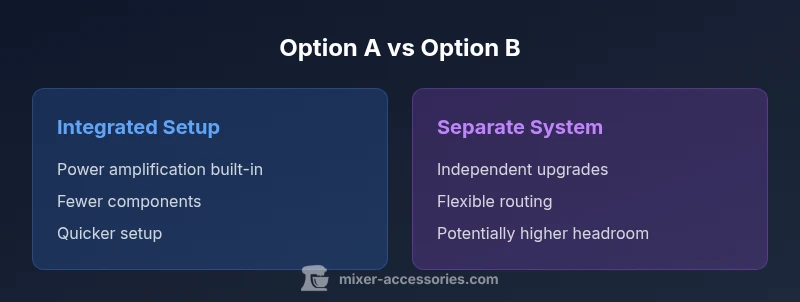
| Feature | Integrated Powered Speaker Setup | Separate Mixer + Passive Speakers with External Amplifier |
|---|---|---|
| Power/Amplification | All-in-one amplification within active speakers | External amplifier needed for passive speakers |
| Control/Routing | Limited routing; centralized control on speakers | Flexible routing via mixer; more hands-on control |
| Connectivity | Built-in input options and DAC; USB often included | Requires mixer I/O plus speaker inputs; more cabling |
| Upgrade Path | Moderate scalability; easy to deploy | High scalability; upgrade components independently |
| Space & Cabling | Less cable clutter; simpler footprint | More cables and boxes; more planning needed |
| Price Range | Typically mid-to-high upfront per system | Potentially lower upfront cost, higher long-term cost with upgrades |
| Best For | Small rooms, quick setup, portability | Larger rooms, studio-grade control, future expansion |
The Good
- Simplified setup with fewer components
- Faster deployment in compact spaces
- Consistent sound from built-in amplification
- Lower maintenance with fewer parts
- Less wiring and fewer adapters
Negatives
- Less flexibility to upgrade components independently
- Headroom and tonal shaping may be limited by speaker amps
- Higher cost per watt in some configurations
- Potentially bulkier active speaker units in small rooms
Integrated mixer + active speakers win for most users
The integrated approach offers simplicity, reliable sound, and a clear path to growth for beginners. The Mixer Accessories team recommends starting with an all-in-one setup for most home users, then expanding as needs evolve.
Your Questions Answered
What is the difference between active and passive speakers?
Active speakers have built-in amplification, so you plug your mixer directly into them without an external amp. Passive speakers require a separate amplifier. Active options are easier to set up and compact, while passive systems tend to offer more upgrade flexibility and potentially higher raw headroom.
Active speakers have amps built in, making setup simple. Passive speakers need a separate amp, which offers upgrade options.
Do I need a dedicated audio interface when using a mixer and speakers?
Most mixers provide line-level outputs that can feed powered speakers or a recording device. If you plan to record at higher fidelity or use digital audio workstations, an interface can add extra conversion quality and routing options.
A dedicated audio interface is optional for simple playback but helpful for recording.
Can I use Bluetooth with a mixer setup?
Bluetooth can be convenient for casual playback but introduces latency and possible interference. If you need precise monitoring for music or video, prefer wired connections and avoid Bluetooth in critical paths.
Bluetooth is handy for streaming but not ideal for precise monitoring.
How many channels should I start with for a home setup?
Start with two to four channels if you primarily use voice and a couple of instruments or apps. Upgrade to more channels if you anticipate multi-mic setups, multiple devices, or live performances.
Two to four channels is a solid starting point; add channels as your needs grow.
Are budget mixers reliable for long-term use?
Budget options can be reliable for basic tasks, but you may sacrifice headroom, build quality, and long-term durability. Prioritize key features like preamp quality, routing, and input compatibility when budgeting.
Budget mixers can work well, but check headroom and build quality.
What setup is best for a small kitchen demo vs a bar night?
For a kitchen demo, a compact two-channel mixer with active speakers is typically sufficient. For a bar night, consider extra channels, robust levels, and dependable connectivity to handle multiple inputs.
Two-channel for kitchen demos; more channels for bar nights.
Top Takeaways
- Choose integrated for compact spaces and ease of use
- Plan upgrades by considering headroom and inputs
- Active speakers simplify setup and reduce cabling
- Separate mixer + speakers offer scalability for studios and live scenarios
- Always test in your room to confirm monitoring accuracy