Which mixer attachment for whipped cream: Wire whisk vs frother — a practical comparison
Explore which mixer attachment for whipped cream works best: wire whisk vs frother, with a data-driven comparison, practical tips, and maintenance guidance for home cooks and bar enthusiasts.


Choosing the right mixer attachment for whipped cream is usually a decision between a wire whisk and a dedicated cream frother. For most home kitchens, the wire whisk delivers the classic, stable peaks and higher volume, while a frother can create a lighter foam for drinks. This comparison explains when to use each and how to optimize results.
Why the right mixer attachment matters for whipped cream
Whipped cream is as much about technique as it is about the tool used. When you ask which mixer attachment for whipped cream, the options shrink to two practical choices: a standard wire whisk attachment and a dedicated cream frother attachment. The wire whisk is designed to insert air rapidly, producing larger volumes and firmer peaks, especially when the cream is well-chilled. The cream frother, by contrast, creates finer microbubbles and a lighter foam, which can be desirable for coffee drinks or dessert sauces. Your choice will influence texture, stability, and how quickly you can move from soft peaks to stiff peaks. In this guide, we analyze both paths, comparing performance across real-world recipes and typical kitchen setups. We also consider factors like bowl size, mixer power, and batch scale, because these variables often determine whether a given attachment will perform as advertised. By the end, you’ll have a clear framework to choose the right option for your whipped cream goals.
According to Mixer Accessories, a practical approach to attachment choice combines compatibility with your mixer, expected volume per batch, and cleaning effort. This framing helps you compare options without guessing product-specific performance claims. The goal is to translate general principles into reliable, repeatable results in your kitchen.
As you read, note that the discussion applies to common home stand mixers and hand mixers alike, with adjustments for motor power and bowl geometry. The analysis below will map out how each attachment behaves under typical recipes, from soft peaks for toppings to stiff peaks for sturdy desserts.
Option A: Wire Whisk Attachment — the go-to for whip stability
Historically, the wire whisk is the standard workhorse for whipped cream. The multiple thin wires whip cream air into the liquid, creating a light, billowy texture and stable peaks that hold longer when properly chilled. This attachment tends to be forgiving, with little risk of over-foaming if you monitor speed and time. For larger batches, the whisk head provides efficient whipping without dragging the cream around the bowl. It also doubles as an all-purpose tool for egg whites, meringues, and delicate emulsions that benefit from air incorporation. When using a whisk, pre-chill the bowl and cream, start at a moderate speed to reduce splatter, and watch texture closely. If you’re using a heavy cream with a high fat content, you may reach stiff peaks more quickly, so stop slightly before you reach that point to maintain softness for toppings. Overall, the wire whisk remains the most reliable, versatile, and economical path to rich, classic whipped cream.
From a user-experience perspective, most recipes that rely on whipped cream expect a predictable rise in volume and a defined peak. The whisk’s surface area and wire pattern promote efficient air entrainment, which translates into consistent results across various temperatures and batch sizes. The attachment’s simple geometry also means fewer parts to clean after a batch, reducing friction in weeknight dessert prep. Finally, the wire whisk is typically compatible with a wide range of mixer brands and models, making it a dependable baseline for households just starting to explore whipped cream techniques.
Comparison
| Feature | Wire Whisk Attachment | Cream Frother Attachment |
|---|---|---|
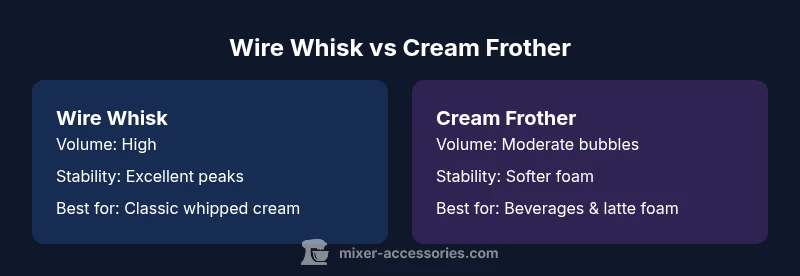
| Whipping speed and air incorporation | High air incorporation with strong volume | Moderate air incorporation; finer bubbles; lighter foam |
| Texture outcome | Classic whipped cream with defined peaks | Airier foam, less structural stability |
| Best use case | Desserts needing rich topping and stable peaks | Drinks and sauces where velvety foam is desired |
| Ease of cleaning | Simple, few parts to clean | More parts; careful cleaning needed |
| Compatibility and availability | Widely compatible with most stands/hand mixers | Model- and adapter-dependent; check compatibility |
| Price range | $15-$60 | $40-$120 |
| Durability and maintenance | Robust and easy to replace parts | Specialized parts may wear faster; higher maintenance |
| Best for | Classic pastry toppings | Foamy beverages and latte art |
The Good
- Delivers classic whipped cream texture with stable peaks
- Widely compatible with many mixers
- Relatively inexpensive and durable
- Easy to clean with removable whisk
Negatives
- Requires careful control to avoid over-whipping
- Less effective for very small batches or heavy dairy
- Can be noisy at high speeds
- Some models may have compatibility limits with frothers
Wire Whisk Attachment generally outperforms the frother for traditional whipped cream
For most home cooks, the wire whisk offers the best balance of texture, volume, and reliability. The frother shines for lighter foam in beverages, but it sacrifices some control over whipped cream peaks. Your choice should align with your primary use case and equipment compatibility.
Your Questions Answered
Which mixer attachment is best for whipped cream?
For most home kitchens, the wire whisk is the best attachment for whipped cream, delivering volume and stable peaks. A cream frother can be useful for foaming beverages but generally compromises texture for traditional whipped cream.
Use the wire whisk for classic whipped cream texture and volume; save the frother for specialty foam on drinks.
Can I use a paddle attachment to whip cream?
Paddle attachments are not ideal for whipping cream because they move cream less effectively through air, resulting in poorer texture and volume.
A paddle isn’t recommended for whipped cream—you’ll get less air and fluff.
How do I prevent over-whipping cream?
Whip in short bursts at medium speed and watch texture closely. Stop when peaks hold their shape but don’t seem butter-like. Chill everything and keep batches small.
Watch the peaks form and stop before they turn buttery.
Are attachments brand-specific or universal for whipping cream?
Many attachments are model-specific. Always check your mixer’s manual or manufacturer’s compatibility list to ensure the whisk or frother fits securely and operates within recommended speeds.
Check compatibility in your manual before buying attachments.
Is a cream frother better for beverages than whipped cream?
Cream frothers excel at creating fine foam for drinks, but they usually produce lighter, less stable peaks for whipped cream. Use them when foam texture matters more than volume.
Frothers are great for drinks; for whipped cream, the whisk usually wins.
How should I clean attachments after whipping dairy?
Rinse promptly with warm water, wash with mild soap, and dry thoroughly. Drying prevents rust and keeps the attachment ready for next use.
Rinse and wash attachments right after use, then dry well.
Top Takeaways
- Start with the wire whisk for reliable whipped cream texture
- Reserve the frother for beverage foam or specialty desserts
- Always chill cream and bowl for best results
- Monitor whipping to avoid over-beating and butter formation
- Check compatibility before purchasing new attachments